



Researchers in Penn State's College of Agricultural Sciences are working with Woodland Biomass Innovations, a startup planning a woody biomass-to-energy facility in north central Pennsylvania, to assess whether the proposed operation would be sustainable and ecologically sound.
Woodland Biomass Innovations is developing a facility designed to convert around 1,000 tons of regional wood residues a day into 42,000 gallons of gasoline, along with biochar and renewable electricity. Founder Luca Pandolfi plans to site the facility in Tioga County, drawing on surrounding forests that include substantial volumes of small-diameter trees typically left unused after timbering.
Dan Ciolkosz, associate research professor of agricultural and biological engineering, said the collaboration benefits the business, the university and the state by combining Penn State Extension's support for the startup with practical research experience for students studying bio-based energy opportunities in Pennsylvania.
College researchers have been modelling the environmental impact of Woodland Biomass Innovations' process and assessing whether nearby forests can sustainably supply enough feedstock. Juliana Vasco-Correa, assistant professor of agricultural and biological engineering, set up a capstone project for fourth-year agricultural and biorenewable systems management students to answer that question using U.S. Forest Service data on northern Pennsylvania's forest resources. The students' preliminary findings indicate forests within 25 miles of the proposed site can sustainably meet the company's projected demand — a distance Vasco-Correa said is significant, since prior research elsewhere has shown that transport costs, both financial and ecological, tend to make biomass projects unviable beyond that radius.
The students also carried out a carbon life cycle assessment comparing gasoline refined from woody biomass with conventional fossil-fuel gasoline, concluding the biomass-derived fuel performed significantly better on environmental impact. Vasco-Correa said the figures are being treated as a starting point, with a postdoctoral researcher now verifying the calculations ahead of final results expected this autumn; early results, she said, look promising for the company.
That postdoctoral researcher, Dominic Aboagye, has a background in bioenergy and spatial optimisation and is leading a team that includes Gamini Mendis, assistant professor of polymer engineering and science and plastics engineering technology at Penn State Behrend, under the supervision of Christine Costello, associate professor of agricultural and biological engineering. Supported by a McIntire-Stennis research project, the team is examining forest biomass availability, supply-chain logistics and environmental impacts tied to woody biomass use in the region, working with Pennsylvania foresters and forestry data.
Costello highlighted transport costs and associated emissions as a key variable, noting that rising and fluctuating diesel prices can make hauling wood expensive, and that feedstock sourcing has a direct bearing on the net greenhouse gas footprint of the resulting gasoline. The aim, she said, is to ensure gasoline produced from northern Pennsylvania woody biomass has a smaller carbon footprint than fossil-fuel gasoline.
Pandolfi said Woodland Biomass Innovations' system is designed for high efficiency, generating much of its own power and producing minimal waste. He added that Penn State's research is important in helping investors understand the project's carbon impact and its effect on local forests, and in validating its carbon intensity relative to fossil fuels.
Penn State Extension specialists, including Ciolkosz, have also been helping Pandolfi connect with the wood-products community, including the Pennsylvania Fuels for Schools and Communities work group. Ciolkosz said the region's abundant low-use woody material, which needs regular harvesting to maintain forest health, makes it well suited to a venture like Woodland Biomass Innovations, which would create a market for that material while supporting the college's longer-term goal of promoting wood-based energy. He noted that building a new industry takes time, and that Penn State Extension has been helping Pandolfi strengthen his business plans as the concept develops.
The collaboration falls under the college's Technologies for Agriculture and Living Systems (TALiS) initiative, which supports businesses combining environmental conservation with economic potential for Pennsylvania, and focuses on the resilience of the state's agricultural, forest, wetland and waterway systems alongside its rural and urban communities.
Gretta Tritch Roman, senior director of research development and initiatives at the college, said Pennsylvania's landscapes offer a strong testbed for integrating technologies across agricultural, natural and social systems.
TALiS coordinator Sara Fitzsimmons said the initiative draws on Penn State's infrastructure and cross-sector partnerships to help move early-stage research toward real-world impact, adding that Woodland Biomass Innovations was among the projects featured at the 2026 TALiS Symposium as an example of that approach.
Penn State researchers assess sustainability of biomass-to-fuel startup in Pennsylvania
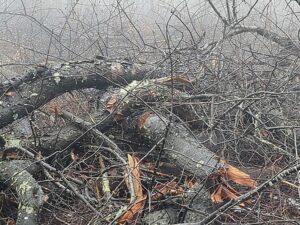
Credit: Luca Pandolfi