



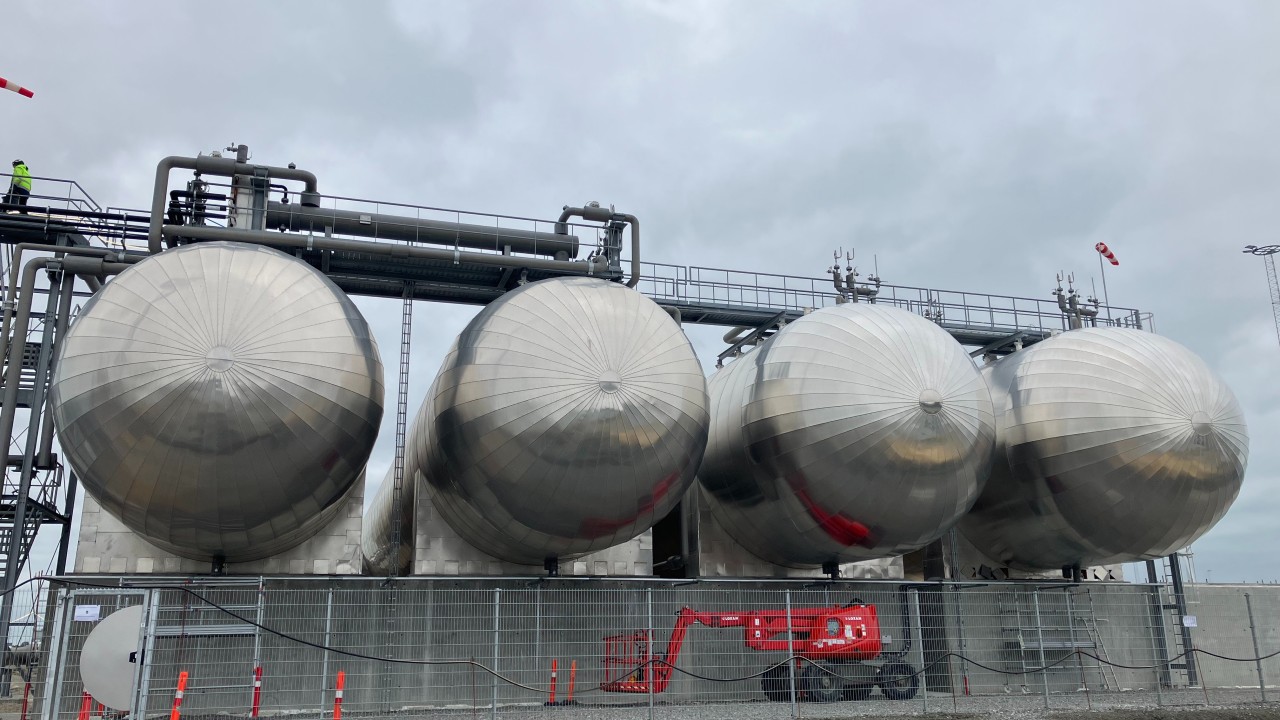
A biomethane facility in central Switzerland has begun commercial operations of an integrated carbon capture and storage chain, marking Europe's first operational commercial-scale BECCS (Bioenergy with Carbon Capture and Storage) project to span multiple countries and transport modes.
The Niederwil installation, operated by Regionalwerke AG Baden (RWB), captures biogenic CO₂ released during anaerobic digestion of agricultural and food waste. The liquefied carbon dioxide is now being transported across borders and injected into subsea geological formations in the North Sea for permanent storage.
The facility will process up to 4,300 tonnes of biogenic CO₂ annually. The capture-to-storage pathway involves a carefully coordinated multimodal logistics chain: truck transport from Niederwil to the regional rail hub at Basel, rail transit across Germany from Basel to Hamburg, and truck drayage to the Port of Esbjerg in Denmark.
From there, the liquefied CO₂ is shipped offshore and injected at Project Greensand in the North Sea, operated by INEOS Energy, where it is injected 1,800 metres beneath the seabed in the depleted Nini West reservoir.
The project accounts for all transport emissions across the supply chain, achieving a net atmospheric removal efficiency of approximately 91.7 per cent.
As a landlocked nation without domestic deep geological storage capacity, Switzerland faces a significant challenge in meeting its legally binding net-zero targets under the Climate and Innovation Act.
The Niederwil project represents the country's first commercial initiative to export captured carbon for international storage and the first non-Danish project to inject carbon at Project Greensand.
Carbon removal credits are certified by the Swiss Federal Office for the Environment. The project's financial sustainability is supported by a CHF 10 million (approximately €10.5 million) pre-purchase commitment from the Climate Cent Foundation through 2030.
By linking decentralised biogenic capture points to Northern European offshore storage infrastructure, the Niederwil operation demonstrates a scalable approach for distributed emitters across the continent.
The model shows how smaller, localised biogas facilities can aggregate logistics to access carbon removal markets whilst contributing to continental net-zero goals.
The project was developed by Airfix, CO₂ Energie AG and South Pole, with logistics coordinated by HOYER Group. Early support came from the Migros Pioneer Fund and Carbon Impact.