



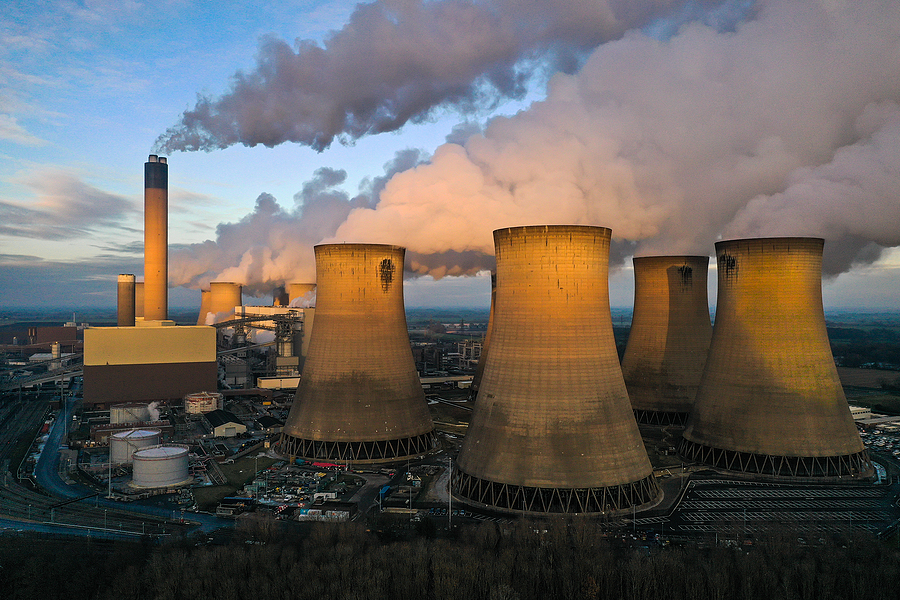
Drax biomass power station was the UK's largest single source of carbon dioxide equivalent (CO2e) emissions in 2025, according to new analysis from energy think tank Ember, marking the eleventh consecutive year the plant has topped the ranking.
Ember's analysis found Drax emitted 14.1 million tonnes of CO2e in 2025, a 1% rise on the previous year, in line with generation increasing from 14.9 TWh in 2024 to 15.4 TWh in 2025 — around 5% of Britain's total power generation, produced by burning 7.5 million tonnes of wood.
Ember calculated this put Drax's emissions at more than four times those of the UK's second-largest emitter, Pembroke gas power station, and higher than the combined emissions of the UK's six largest gas power stations.
Two other UK biomass plants also featured prominently in Ember's ranking: Lynemouth, which the analysis placed as the sixth-largest emitter at around 2.4 MtCO2e (up 35% year-on-year), and Teesside, ranked 16th at 1.2 MtCO2e. Combined, Ember said the three biomass plants emitted 17.7 MtCO2e in 2025 — more than the nine most polluting gas power stations combined, according to its figures.
Ember's analysis also found Drax received £999 million in public subsidy support in 2025, funded through consumer energy bills, which it calculated as costing UK households around £13 each. The think tank put Drax's cumulative subsidy total for biomass burning since 2012 at £8.72 billion.
The carbon accounting debate
Under current UK and EU emissions trading rules, biomass power generation is treated as carbon-neutral at the point of combustion, on the basis that emissions are offset by forest regrowth over time — meaning Drax's direct biomass emissions are not counted in official UK Emissions Trading Scheme figures or national emissions statistics, and biomass generation remains eligible for renewable energy subsidies. This accounting approach follows UNFCCC and IPCC conventions designed to avoid double-counting emissions across the energy and land-use sectors.
Ember and some other bodies, including the European Academies Science Advisory Council, have argued this framework understates the climate impact of large-scale biomass burning, given the extended timeframes — sometimes decades — required for forest regrowth to reabsorb an equivalent volume of carbon.
Drax and other biomass advocates maintain that sustainably sourced, certified biomass delivers genuine carbon savings over its full lifecycle when sourced and managed appropriately; the extent to which this holds in practice remains a live and contested question across the sector, and one on which independent auditors, government bodies and NGOs continue to disagree.
Feedstock sourcing and subsidy changes ahead
Ember's analysis noted that more than 99% of the wood fibre burned by Drax between 2023 and 2025 was imported, with 86.7% of 2025 feedstock sourced from the US and Canada — where Drax operates 17 pellet mills — and a further 13.2% from Europe, primarily Latvia. Less than 1% was UK-sourced.
Subsidy arrangements for Drax and Lynemouth are due to change from April 2027, when both plants move to a new government support agreement capping subsidised generation at a 27% capacity factor, alongside a higher strike price of £153/MWh (2024 prices).
The government has said this will roughly halve the subsidy paid to each plant, which Ember estimates would reduce the annual cost per household from around £13 to £6. Ember's analysis projects Drax's emissions will fall to around 5.8 MtCO2e between 2027 and 2031 as a result, but says the plant is still likely to remain the UK's largest single emitter into the early 2030s, absent a significant increase in unsubsidised generation.
Drax has previously indicated reduced confidence in delivering its proposed carbon capture project at the site; Ember's analysis estimates that a full transition to bioenergy with carbon capture and storage (BECCS) at Drax would require in the region of £30 billion in additional subsidy.