


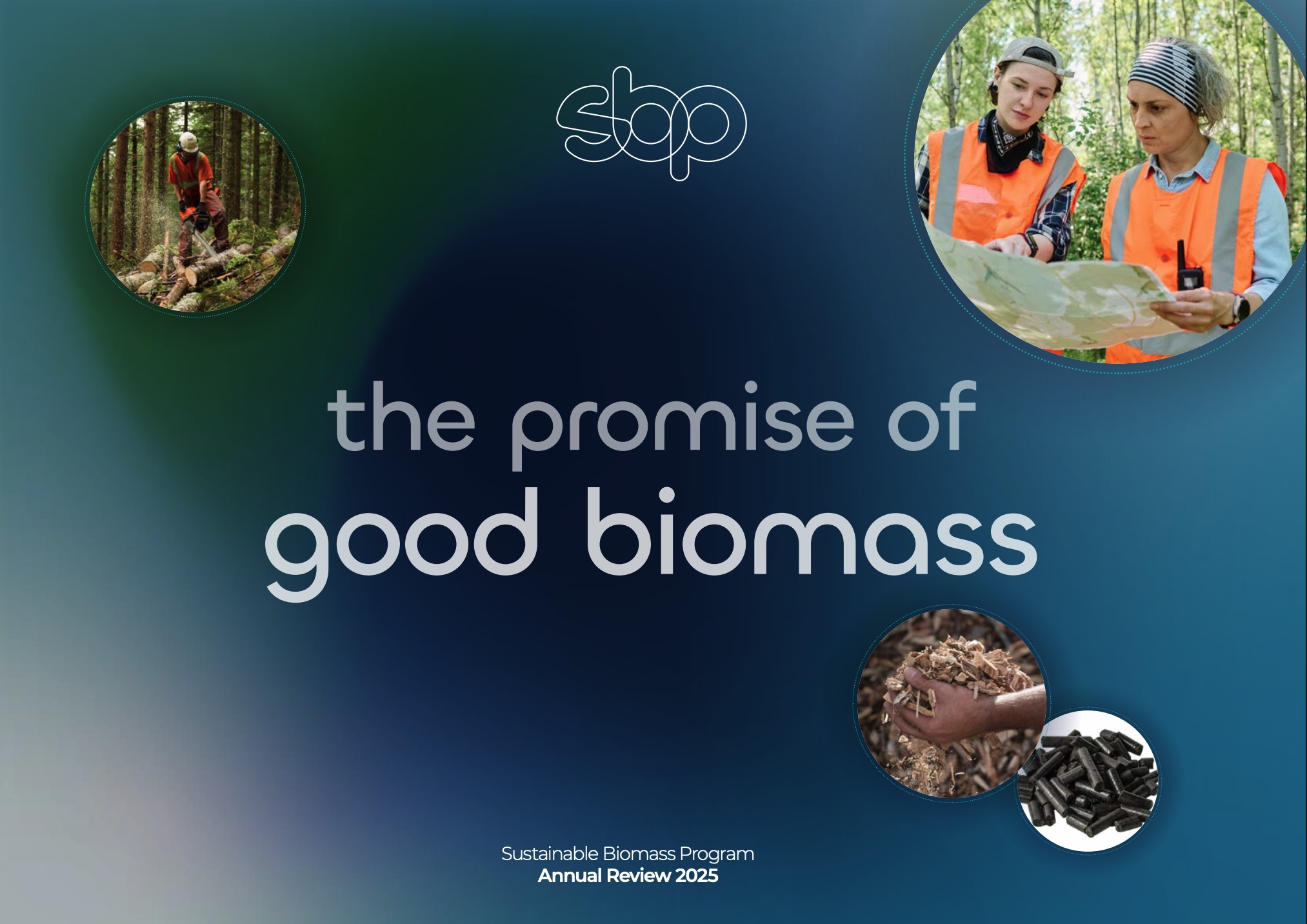
The Sustainable Biomass Program (SBP) has published its annual review for 2025, reporting a year of significant growth in certified volumes, a landmark transition to updated standards, and formal recognition under the EU's revised Renewable Energy Directive as the scheme positions itself for an expanded role across industrial and hard-to-abate sectors.
Total SBP-certified biomass produced and sold reached 22.80 million tonnes in 2025, up 19% on the 19.15Mt recorded in 2024. Consumption of SBP-certified biomass in Europe climbed 23% to 21.70Mt, with SBP-certified material accounting for 89.1% of European industrial pellet consumption, compared with 84.7% the previous year. Of the total volume produced and sold, 15.90Mt was pellets and 6.90Mt was chips.
The number of certificate holders grew from 340 to 405 over the course of the year, comprising 267 biomass producers, 75 traders and 63 end-users. A further 37 organisations had applications in progress at year end. The scheme's geographic footprint remained at 35 countries, with Liberia and Thailand added and Bulgaria and Finland lost.
Standards transition
The transition to SBP Standards v2.0 concluded on 9 November 2025, marking what the organisation described as a pivotal milestone. Of active certificate holders, 97% met the deadline, with only five suspended for non-compliance. No certificate holders terminated participation as a result of transition requirements, which SBP said indicated strong sector confidence in the enhanced framework.
Chief executive Carsten Huljus described the transition as the organisation's 'core task' for the year. Support was delivered through webinars, workshops, auditor calibration sessions and an expanded helpdesk, alongside translation of key materials into French and other languages to support uptake in a broader range of markets.
Digital tools were also refined to streamline data capture and reporting.
Work on Standards v2.1 began mid-year, with draft text integrating all normative interpretations, updating more than 50 clauses, expanding the glossary and reinforcing alignment with REDIII no-go area criteria approved by the standards committee for public consultation in December. The revised version is scheduled for release in 2026.
REDIII recognition
In May 2025, the European Commission issued a positive technical assessment confirming SBP's recognition under the Renewable Energy Directive (REDIII, EU/2023/2413). The recognition confirms the scheme meets REDIII requirements for reliability, transparency and independent auditing, enabling SBP certificate holders to certify compliance with the directive's sustainability and greenhouse gas saving criteria.
Recognition covers three feedstock categories: lignocellulosic material from forest and non-forest land; processing residues from forest and agriculture-related industries; and woody post-consumer waste feedstock. It applies to biomass fuels (pellets and wood chips) produced from these materials for heat and electricity production.
Belgium, Denmark, the Netherlands and the United Kingdom all maintain specific national requirements that SBP Standards accommodate through market-specific modules. In Japan, SBP's recognition under the feed-in tariff and feed-in premium systems was formally announced in the Japan Official Gazette in January 2025, following the government's initial recognition in September 2023.
Regional risk assessments
SBP significantly expanded its regional risk assessment (RRA) programme during the year. In the first half of 2025, interim RRAs were published for Alberta, British Columbia, New Brunswick, Nova Scotia and Quebec in Canada, alongside US national forest, US private forest and Vietnam forest assessments. A dedicated public consultation on a Norway forest draft RRA was launched in July.
By the fourth quarter, new SBP-endorsed RRAs had been published for US national forest and US private forest, alongside an interim RRA for Norway. The year also saw completion of REDIII Level A risk assessments for seven regions, with certificate holders granted a six-month transition window to incorporate those updates into their supply base evaluations. By year end, the total stood at 16 RRAs covering nine countries, up from six countries at the start of the 2023–2025 strategy period.
Huljus said RRA expansion had been a consistent priority throughout the strategy cycle. 'RRAs reduce duplication and ambiguity for certificate holders and make our risk approach more transparent and comparable across regions,' he said.
Assurance activity
Certification bodies conducted 514 audits of certificate holders during the year, up from 384 in 2024. Of these, 97 were main audits, 304 were annual surveillance audits, 22 were re-certifications and 51 were scope change audits. The remaining 40 covered transfer audits, non-conformance verification audits and additional audits.
The ANSI National Accreditation Board (ANAB), which manages SBP's accreditation programme, conducted 17 assessments of certification bodies during the year, including 11 witness assessments and six head office assessments. SGS, headquartered in Switzerland, achieved ANAB accreditation and formal SBP approval in December, bringing the total number of approved certification bodies to five. Indonesia-based MUTU International is expected to complete accreditation in the second half of 2026.
There were 12 incidents recorded or investigated during 2025, of which seven were resolved within the year. No complaints relating to the assurance programme were received, compared with three in 2024.
New markets and feedstocks
Thailand entered the SBP-certified supply chain for the first time in 2025. PT Parawood, a rubberwood pellet producer operating in southern Thailand, became the country's first SBP-certified biomass producer, with its Sadao facility certified in October and a new Lampod site, covering 86,400 square metres with an annual capacity of 160,000 tonnes, certified in December. The company sources feedstock exclusively from rubberwood plantations operating on a natural 20–25 year cycle.
SBP also continued technical groundwork for extending certification to non-woody feedstocks, including energy crops and agricultural residues. A public consultation on Instruction Document 1B, setting out requirements for non-woody feedstocks, was launched during the year, and a pilot test of the updated requirements was completed in February 2026.
Growing momentum in pyrogenic biocarbon, which encompasses biochar, biocoal and biocarbon, was highlighted as a further area of expansion. SBP said these materials provide a gateway to industrial end-use sectors including cement, iron and steel, as well as a range of bio-based applications.
BECCS and carbon
The review gives prominence to SBP's evolving role in supporting biomass-based carbon removals, particularly bioenergy with carbon capture and storage (BECCS).
Stockholm Exergi, operator of one of Europe's largest bio-combined heat and power plants, is constructing a BECCS facility at its Värtan plant in central Stockholm that will capture 800,000 tonnes of biogenic CO2 per year from 2028, making it one of the world's largest BECCS installations. The project relies on SBP-certified biomass for upstream carbon accounting and regulatory compliance.
SBP's Carbon Working Group, established in late 2024, made significant progress during 2025 on carbon stock assessment guidance, the use of IPCC-based national inventories and remote sensing, and criteria for identifying high carbon stock forest areas. An Excel-based GHG calculator was prepared for external verification ahead of planned digitalisation.
Huljus was clear that SBP's role in the carbon landscape is defined by its chain of custody and data capabilities rather than post-combustion verification. 'Our most valuable contribution is providing dependable data and assurance of claims that others — policymakers, regulators, supply chain actors — can rely on,' he said.
Data and digital tools
The Data Transfer System (DTS) recorded 12,441 transactions in 2025, up from 9,524 in 2024. Key enhancements during the year included the introduction of a transaction inventory to improve traceability and a continued expansion of the voluntary EUDR module, including integration with the EU TRACES NT system enabling certificate holders to submit due diligence statements directly via the DTS. An updated user guide (v1.1) was published in September.
SBP also advanced a partnership with GTS Global Traceability Solutions on the EUDR module, enabling enhanced data capture and risk screening to support certificate holder compliance with the EU Deforestation Regulation.
Stakeholder engagement and regional forums
Three regional forums were held during 2025, expanding on the initiative established in 2024. The second Asia Forum took place in Hanoi in February, drawing 37 participants with discussion focused on Vietnam's forestry sector, EUDR readiness and challenges facing smallholders.
The inaugural Americas Forum was held in Atlanta in June, attended by approximately 50 participants, with sessions on small private landowner needs and the new US RRAs.
The first Europe Forum took place in Brussels in October, bringing together 44 participants from 12 countries for discussions on voluntary certification frameworks, cascading use and EUDR traceability.
SBP also hosted biannual certification body summits and delivered in-person training sessions in Hanoi, Copenhagen and Riga, with more than 40, 20 and 45 participants respectively. A total of 53 auditors completed v2.0 training during the year, bringing the total number of qualified auditors to 131.
A certificate holder satisfaction survey conducted in the first quarter found that 86% of respondents rated SBP at three or higher out of five, and 93% said SBP had added value to their business.
The most valued benefit cited was SBP's role in facilitating trade, followed by regulatory acceptance and compliance. The most frequently cited challenges were conducting risk assessments, EUDR compliance and using the audit portal.
Governance and financials
The board established a third standing committee called the Risk and Assurance Committee in October 2025, providing independent oversight of the organisation's risk profile. John-Paul Taylor joined the board in July to represent biomass producer interests, while Alan Knight stood down from the end-user seat in October.
Total income for 2025 was €4.46m, up from €3.52m in 2024. Total expenditure fell to €3.13m from €3.41m, reflecting the return to normal levels of strategy project spend following the elevated costs associated with the v2.0 rollout in 2024. The largest expenditure category was secretariat staff costs at €1.30m, followed by consultants and services at €412,000 and IT software at €371,000.
The organisation published its 2026–2030 strategy during the year, adopting a five-year cycle rather than the previous three-year cycle and framing its priorities within a longer-term outlook to 2040.
Chair Francis Sullivan said the board had concluded that evolution rather than revolution was the right approach, building on foundations laid during the previous cycle.