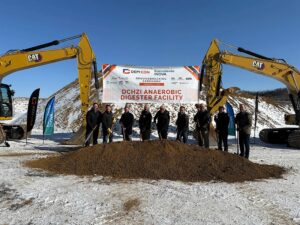



Kanadevia Inova has broken ground on what it describes as one of the most advanced organic waste-to-renewable gas projects in North America, establishing what the company says is a new benchmark in circular waste management and renewable energy production.
The Louisville Township Renewable Gas Project, located in Louisville Township, Minnesota, is a large-scale anaerobic digestion facility developed by Kanadevia Inova in partnership with Dem-Con Companies, LLC.
The site will begin receiving organics for processing in 2027.
Once operational, the facility will process up to 75,000 tonnes of organic materials per year, producing approximately 200,000 MMBtu of renewable natural gas (RNG) annually — enough to power around 2,700 US homes year-round.
It will also generate around 8,000 tonnes of biochar each year, making it the first facility of its kind to produce the carbon-sequestering byproduct alongside biomethane.
The project was developed in response to policy goals set by the State of Minnesota and local municipalities seeking to reduce greenhouse gas emissions, divert organic waste from landfill, and increase renewable energy production.
Organic feedstock will include both source-separated organics collected in compostable bags and the biodegradable fraction of municipal solid waste (MSW). Food waste accounts for around 24% of average household waste — more than any other single material — and when disposed of in landfill produces methane and CO2 as it decomposes.
The facility's primary feedstock supplier is Ramsey/Washington Recycling & Energy (R&E), a public joint powers organisation serving Ramsey and Washington counties.
CenterPoint Energy and Xcel Energy will support the project through offtake and utilisation of the RNG produced, under provisions of the Minnesota Natural Gas Innovation Act.
The project combines high-solids anaerobic digestion (HSAD) with gasification technology — an integrated approach that addresses the challenge of treating impure organic waste streams.
In conventional anaerobic digestion, bacteria break down organic material in an airtight tank without oxygen, producing biogas comprising approximately 60% methane and 40% carbon dioxide.
This biogas is then purified to remove CO2 and other impurities, yielding pipeline-quality natural gas. The remaining digestate is converted into biochar through gasification.
Biochar can be used in soil remediation, filtration, and as a soil amendment to retain moisture and nutrients, while also sequestering carbon. Research has also indicated that the gasification process and subsequent use of biochar in soil remediation show promise in reducing PFAS — the class of toxic persistent chemicals commonly referred to as "forever chemicals".
Heath Jones, Regional President North America at Kanadevia Inova, said: "This cutting-edge facility will convert the organic fraction of municipal waste from surrounding counties into renewable energy through anaerobic digestion, biogas upgrading, and advanced gasification. In addition to biomethane, it will be the first facility of its kind to produce biochar, a carbon-sequestering byproduct that reduces the plant's carbon intensity and creates valuable applications for agriculture and industry."
Fabio Dinale, Executive Vice President and Head of Business Development at Kanadevia Inova, added: "The groundbreaking marks a significant step toward a more sustainable and resilient waste and energy infrastructure in North America."
Funding for the project was provided by the Minnesota Environment and Natural Resources Trust Fund, as recommended by the Legislative-Citizen Commission on Minnesota Resources, and by a grant from the Minnesota Department of Commerce. R&E's ongoing access to the facility will be supported by the State of Minnesota through its State Competitiveness Fund Matching Funds programme.
Kanadevia Inova breaks ground on Minnesota’s first organic waste-to-biochar renewable gas facility