



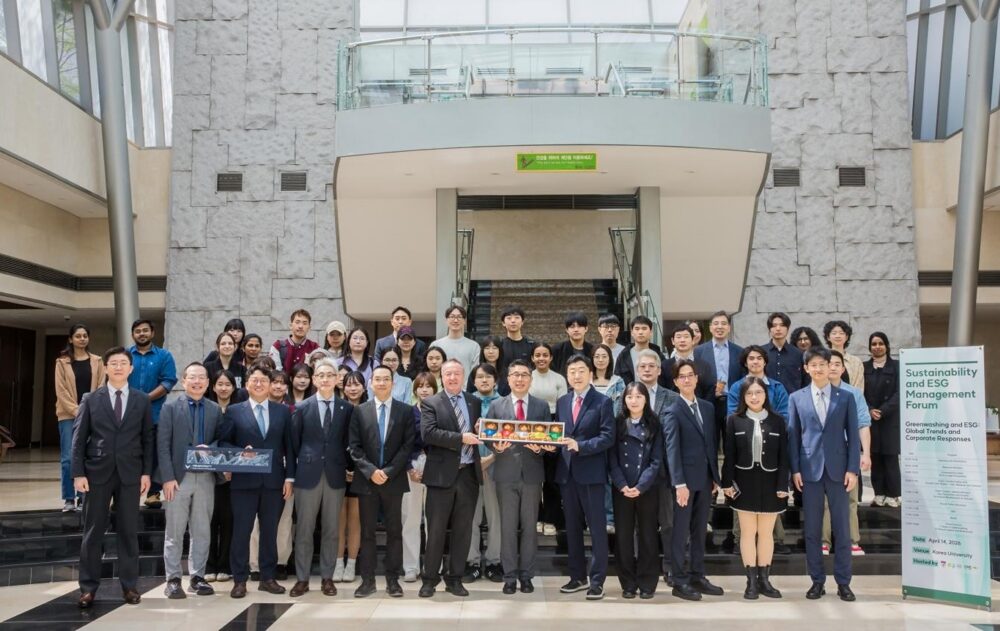
A research team led by Professor Yong Sik Ok of Korea University has developed a suite of technologies aimed at closing the loop on waste, with a hybrid biomass-to-energy system showing particularly strong results.
Ok's broader programme covers plastic upcycling, waste system resilience, and organic waste-to-energy conversion. The unifying principle is treating waste streams as resource inputs rather than disposal problems — a shift from linear reduction strategies toward genuinely circular models.
The most technically notable output is a hybrid system combining microbial electrolysis cells (MEC) with conventional anaerobic digestion (AD), developed in collaboration with Professor Xue-Ting Wang of Harbin Institute of Technology. Standard AD breaks down organic matter in oxygen-free conditions to produce methane, but the process is prone to efficiency losses through over-acidification. The hybrid design addresses this through functional partitioning: bio-anodes are dedicated to methane generation, bio-cathodes stabilise pH and process conditions, and suspended microbial communities handle organic matter breakdown. Low-voltage electrical inputs stimulate microbial activity throughout.
Results published in Bioresource Technology and Chemical Engineering Journal report a 65.4% uplift in methane production alongside improved process stability. The system has been tested across multiple feedstocks, including fruit and vegetable waste and waste activated sludge.
Outputs extend beyond methane. Carbon dioxide generated during the process can be redirected into chemical production, while nutrient-dense digestate residues are suitable for use as agricultural inputs. The methane itself can fuel electricity generation, heat supply, or be upgraded to biomethane for injection or transport use.
Ok has also published work in Nature Reviews Earth & Environment arguing for intelligent material design at the production stage as a prerequisite for effective downstream upcycling — framing circularity as a design challenge as much as a waste management one.