



South Korean researchers have developed a process that transforms wet spent coffee grounds directly into high-calorific biochar in under two minutes, bypassing the energy-intensive drying steps that have long constrained biomass valorisation.
The flame plasma pyrolysis (FPP) method, developed at the Korea Institute of Geoscience and Mineral Resources, uses an atmospheric-pressure plasma jet fuelled by liquefied petroleum gas to process coffee grounds at around 55% moisture content — with no pre-drying or de-oiling required.
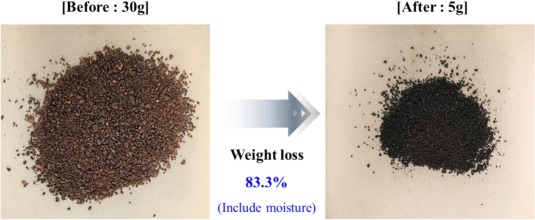
At the optimal treatment time of 90 seconds, the process achieved a mass reduction of 83.3% and produced a biochar with a higher heating value of 29.0 MJ/kg — comparable to standard anthracite coal and around 33% higher than the raw feedstock. Fixed carbon content increased approximately threefold, from 15.6% to 46.2%, while sulfur was completely eliminated, promising negligible SOx emissions during combustion.
The researchers attribute the rapid pore development to what they describe as a 'popcorn effect': the intense heat flux triggers flash evaporation of the material's inherent moisture, generating internal pressure that expands the carbon matrix and creates a highly porous structure. At 90 seconds, specific surface area peaked at 115.4 m²/g, compared with just 1.5 m²/g in untreated grounds.
The process represents a 90- to 120-fold reduction in residence time compared with conventional pyrolysis methods, which require extended pre-drying and treatment periods. The researchers calculate a specific energy consumption of approximately 154 MJ/kg of biochar at optimal conditions, and suggest the compact system is suited to decentralised, on-site deployment — removing the logistical burden of transporting high-moisture waste.
Over 10 million tonnes of spent coffee grounds are generated globally each year, the majority of which are landfilled or incinerated.