



Bulgarian pet food producer Furajny Hrany Ltd. has officially opened its second KARA biomass boiler house at its production facility in Lovech.
The new 3.4 MW biomass combustion installation represents an important milestone in the company's development and further strengthens its commitment to circular production, renewable energy and the reduction of its carbon footprint.
The new installation builds on a sustainability journey that began almost a decade ago. In 2017, Furajny Hrany commissioned its first 2.3 MW KARA biomass combustion installation. With the addition of the new 3.4 MW system, the company has now expanded its KARA biomass capacity to a combined 5.7 MW.
From agricultural residue to renewable energy
What makes the project particularly significant is the circular approach behind the energy supply. Furajny Hrany grows agricultural crops that provide base ingredients for its dog and cat food production. Straw remaining from its own agricultural activities is used as fuel in the KARA biomass installations.
Instead of relying on natural gas to generate the process heat required by the factory, an agricultural residue from the company's own supply chain is converted into renewable thermal energy.
This creates a highly integrated circular production model: agricultural crops provide ingredients for pet food, whilst the residual straw is converted into energy to support the manufacturing process.
Through its investment in biomass technology, Furajny Hrany has eliminated its dependence on natural gas for this heat production and achieves an estimated CO₂ reduction of more than 10,000 tonnes per year.
This places the Lovech production facility amongst the pet food plants demonstrating how locally available biomass residues can be integrated into industrial production on a substantial scale.
Official opening on 3 September
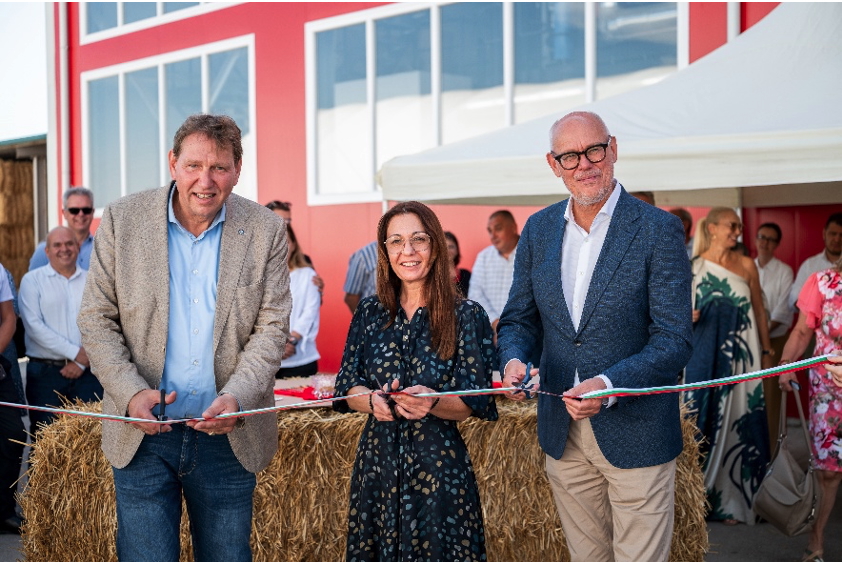
The new boiler house was officially opened on 3 September 2026 by Desislava Hristova-Stankova, owner of Furajny Hrany Ltd.; H.E. Arthur den Hartog, Ambassador of the Kingdom of the Netherlands to Bulgaria; and Robert Reinders, CEO of KARA Future Energy Systems. Arthur den Hartog is the current Dutch Ambassador to Bulgaria.
The opening ceremony symbolised not only the commissioning of a new energy installation, but also the continuation of a long-term partnership between Furajny Hrany and KARA Future Energy Systems.
"The opening of the second boiler house is an important milestone for our company. By using straw from our own agricultural activities to produce the energy required for our production process, we are turning a residual product into a valuable energy source. This allows us to combine growth with a substantial reduction in our use of fossil energy," said Hristova-Stankova.
A partnership that started in 2017
For KARA Future Energy Systems, the second installation demonstrates how industrial biomass projects can develop alongside the growth and changing energy requirements of a customer.
"When the first 2.3 MW KARA installation was commissioned here in 2017, it was the beginning of an ambitious transition. Today, with another 3.4 MW of biomass capacity in operation, we can see what a long-term commitment to renewable energy can achieve. Furajny Hrany does not simply purchase biomass fuel – it creates the fuel within its own agricultural value chain. That is circular energy in practice," said Reinders.
The combination of agriculture, food production and renewable heat generation is particularly relevant for industries looking for practical ways to reduce fossil-fuel consumption. Instead of transporting energy resources over long distances, Furajny Hrany uses an agricultural residue generated close to its own operations.
Sustainability as part of the production model
Furajny Hrany produces dog and cat food in Lovech, Bulgaria, and operates under ISO 9001 and ISO 22000 certified quality-management and food-safety systems.
The second KARA boiler house adds another important dimension to this production model: energy generation based on a renewable residue originating from the company's own agricultural activities.
With a combined installed biomass capacity of 5.7 MW, the replacement of natural gas for the relevant heat demand, and an estimated annual reduction of more than 10,000 tonnes of CO₂, the project illustrates how industrial decarbonisation and circularity can be combined without separating energy strategy from the underlying production process.
From field to food, from residual straw to renewable heat – Furajny Hrany is closing the circle.