




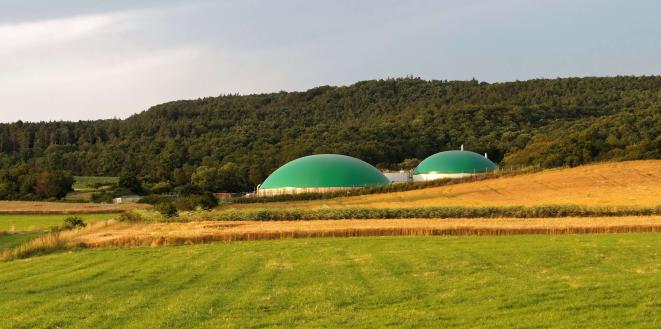
The National Energy System Operator has called for a strategic approach to biomethane production, warning that sustainable output can reach 30 TWh annually by 2050 without material dependencies or environmental trade-offs — but scaling beyond that threshold requires cross-sector assessment of competing land and feedstock priorities.
Current UK biomethane injection stands at 6 TWh annually (around 1% of gas demand). NESO's analysis, released as part of the Gas Market Roadmap, explores pathways reaching 64 TWh by 2050, but flags increasing dependencies on agricultural and environmental sectors as ambition climbs.
Strategic value emerging across hard-to-decarbonise sectors
NESO identifies three end-use applications where biomethane delivers significant carbon and cost benefits: low carbon dispatchable power (LCDP), hard-to-electrify industry, and transport.
Modelling suggests biomethane availability for power generation could reduce future power system costs by deferring new infrastructure investment, though achieving these savings hinges on long-term infrastructure planning certainty.
For dispersed industrial sites (around half of hard-to-electrify gas demand), biomethane may represent the most practical decarbonisation route where hydrogen and carbon capture and storage (CCS) infrastructure remains unavailable.
In transport, current uptake concentrates on heavy goods vehicles (HGVs), supported by the Renewable Transport Fuel Obligation and reduced fuel duty—though methane leakage concerns limit long-term strategic value.
Five feedstocks could drive scale-up
Grassland (29 TWh potential), rotational crops (27 TWh), sequential crops (17 TWh), agricultural residues (15 TWh) and livestock waste (11 TWh) represent the highest-growth feedstock mix.
However, each carries assumptions and risks: grassland potential depends on 38% livestock reduction (per Climate Change Committee projections); rotational and sequential crops risk competition with food production if price signals shift; and sequential crop harvesting poses soil compaction risks if not managed rigorously.
The external analysis assumes crops grown for biomethane would complement — not compete with — food production via existing rotational systems, and that livestock reduction frees marginal grassland for managed production. NESO cautions these assumptions require testing through cross-sector collaboration.
Methane leakage, digestate logistics, and grid constraints loom
Methane leakage at production sites can undermine climate benefits; stakeholder feedback suggests modern technology can achieve sub-1% leakage with stringent standards.
Digestate management (the nutrient-rich by-product) requires post-processing infrastructure for scaling. And gas grid constraints — already limiting injection in summer months — will intensify if overall gas demand falls or biomethane production accelerates; propanation (supplementing biomethane with propane for calorific value) adds cost friction.
Production costs comparable to hydrogen; policy support critical
Levelised production costs range £73–£135/MWh, roughly matching projected hydrogen costs (£73–130/MWh) but significantly above natural gas with carbon pricing (£26–70/MWh by 2050).
The Green Gas Support Scheme currently bridges this gap; government is expected to consult on a successor framework post-March 2028, but producers have warned that policy uncertainty risks investment stalling.
Carbon capture opportunity
Captured CO₂ from biogas upgrading offers a lower-cost greenhouse gas removal route (£84–213/tCO₂) compared to direct air capture (£325–842/tCO₂). At 30 TWh production, this could deliver ~4 MtCO₂ removals annually if all plants captured and stored CO₂ — around one-tenth of engineered removals assumed in the Climate Change Committee's net-zero pathway.
However, most plants would require CO₂ trucking to access piped networks, making infrastructure and policy frameworks for non-pipeline transport critical.
No specific UK target; government decision looms
NESO stops short of recommending a specific production ambition, framing 30 TWh as achievable without significant cross-sector friction and 64 TWh as feasible but requiring closer assessment of land-use trade-offs, biodiversity priorities, and competing feedstock demands (e.g., from sustainable aviation fuel).
The strategic decision on ambition is for government—but current policy drift risks leaving the sector without the long-term visibility needed to unlock infrastructure investment and plan hard-to-decarbonise sectors accordingly.