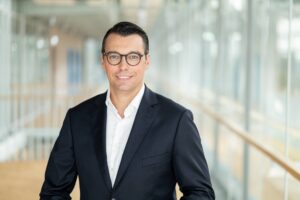






Jörg Lennertz, VORN Bioenergy’s new CEO, tells Bioenergy Insight about his vision and the lessons he is carrying across from utility-scale renewables
VORN Bioenergy recently appointed Jörg Lennertz as CEO and Manuel Fernández Durán as chief financial officer, completing a new management team that the Regensburg-based biomethane developer said is built for the next phase of its European growth strategy.
Lennertz joins from Uniper, where he played a central role in building the company's multi-gigawatt European renewable energy business. Fernández brings more than 18 years of CFO experience, most recently at offshore wind developer BlueFloat Energy, with particular depth in project financing and scaling finance functions. They join chief operating officer Michael Wallis Olausson, who came aboard in February 2025 with over 15 years of biogas industry experience focused on project construction and operation.
The trio succeeds a leadership team that spent three years restructuring and repositioning the business. Chris Archer, head of Macquarie Asset Management's Green Investments EMEA – VORN's shareholder – paid tribute to outgoing CEO Thorsten Holl and Dirk Simons, while making clear his confidence in the new appointments. "The complementary strengths Jörg, Manuel and Michael bring position VORN exceptionally well to deliver on its growth ambitions," he said.
Those ambitions are substantial. VORN Bioenergy is targeting 2 TWh of biomethane production per year by 2030, operating across Germany, Italy, Spain, Portugal and Poland. With more than 40 bioenergy projects realised over two decades, the company's foundations are established – but Lennertz is clear that the next chapter demands a step change in scale and commercial sophistication.
From electrons to molecules
Lennertz is candid about the differences between the renewables world he comes from and the biomethane sector he is now leading. "I have utmost respect for our colleagues and partners in the biomethane industry, who navigate an immense level of complexity compared to technologies such as onshore wind and solar PV," he told Bioenergy Insight.
That complexity is precisely where experience from the mature renewables industry can add value. The way VORN approaches commercial offerings to offtake markets, the standards it sets in plant design and engineering, and the partnerships it builds with feedstock suppliers, financiers and technology partners – all of these can be informed by lessons from wind and solar, even if the underlying technology is fundamentally different.
"The complexity in producing green molecules versus electrons is the obvious difference, but there are plenty of experiences from the renewables industry that can be successfully applied," he added.
"I share the same underlying motivation: driving Europe's energy transition towards zero emissions to help create a healthier planet. I'm convinced sustainability is and will be the competitive edge of Europe's economies."
Spain, Italy and the Iberian push
VORN's geographic strategy centres on markets where biomethane can be embedded into existing agricultural and industrial supply chains, rather than imposed upon them. Nowhere is this more apparent than in Spain, where the company has developed a project utilising residues from olive oil production – transforming what would otherwise be an environmentally harmful waste stream into biomethane, fertiliser and biogenic CO₂ for the beverage and chemical industries.
"We transform environmentally harmful residues into green gas, valuable fertiliser for agriculture and CO₂ for the beverage and chemical industry," Lennertz explained. "Through this approach, we embed sustainability by enabling circularity across Spain's olive oil industry – the world's leading producer."
That Iberian footprint is now extending into Portugal through a newly announced co-development partnership with Prado Energia. Under the agreement, Prado will lead project development, drawing on local market expertise, while VORN contributes technical capabilities and project financing. Initial projects target a grid injection capacity of 67 GWh each – equivalent to the thermal energy demand of 20,000 households – with one project already designated as a Projeto de Potencial Interesse Nacional, a status expected to streamline permitting. The initial development phase represents investment in the mid double-digit million-euro range and is projected to avoid approximately 75,000 tonnes of CO₂ emissions annually.
In Italy, meanwhile, VORN is constructing what will be one of the largest new-build biomethane facilities in the country, located in the municipality of Ferrara. The plant is designed to produce 8.5 million Nm³ of biomethane per year and has secured project financing from ING Italia, which is also acting as Hedging Bank and Sustainability Coordinator. Construction began in November 2024, with initial completion targeted for mid-2026.
A notable feature of the Ferrara facility is its approach to landscape integration. Rather than imposing industrial infrastructure on agricultural land, the plant uses earth fermenter technology constructed using soil from the site itself, minimising visual impact. The feedstock mix will comprise 60–70% livestock manure and 30–40% renewable raw materials and agricultural by-products. At full operation, the facility is expected to create around 10 direct jobs and approximately 20 further positions with service providers, alongside supply chain employment across roughly 80 agricultural businesses.
The financing structure includes accordion facilities, allowing VORN to efficiently raise further support for additional Italian projects while retaining flexibility to bring in new lenders – a design that signals the company's intent to replicate the model across its Italian pipeline.
Building for offtake
Underpinning the entire growth strategy is a commercial model built around securing long-term relationships with both feedstock suppliers and large biomethane offtakers. Lennertz describes this as crucial to navigating the sector's complexity. "Building strong relationships and strategic partnerships is the key to mastering the complexities and unlocking significant benefits for all parties involved," he said.
The company is also pushing biomethane into new end-use sectors, including the maritime industry, as well as fertilisers and biogenic CO₂ - markets that could significantly broaden the commercial base for the gas beyond conventional heating and industrial applications.
On the technology side, VORN is investing in advanced digestate treatment and the revamping of brownfield sites in Germany, where it sees significant untapped potential in upgrading existing biogas infrastructure to produce grid-quality biomethane.
"Commercial success and environmental impact is not a trade-off – they go hand-in-hand," Lennertz says. "This is one of the privileges of working in bioenergy."
With a strengthened management team, a growing project pipeline across five markets and a financing structure designed for replication, VORN Bioenergy is positioning itself as one of the more ambitious independent biomethane developers on the continent. Whether it can convert that ambition into 2 TWh of annual production by 2030 will depend on execution – but the building blocks are firmly in place.
VORN Bioenergy sets course for two TWh by 2030