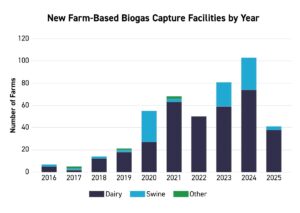






The number of farms in the United States operating biogas capture systems has more than doubled since 2020, according to new data from the American Biogas Council (ABC), though the industry body warns that the vast majority of agricultural biogas potential remains untapped.
Released on 24 March to coincide with National Agriculture Month, the ABC data shows 631 farms now operate biogas systems, up from around 300 five years ago. Those farms can produce over 61 million MMBtu of energy annually, compared with approximately 23 million MMBtu in 2020, a 166% increase.
41 new systems came online in 2025, representing $835 million in investment. Total capital invested in farm-based biogas systems has now reached $6.4 billion.
Dairy farms account for 79% of operational systems, with hog farms making up a further 19%. Together they process 25 billion gallons of manure annually, generating enough energy to meet the needs of around 800,000 US homes while also reducing methane emissions and recycling nutrients back into agricultural soils.
The mix of end uses has shifted markedly since 2020. Three-quarters of systems then generated on-site power; today roughly two-thirds produce renewable natural gas (RNG) for pipeline injection or use as a transportation fuel, reflecting the influence of policy incentives including California's Low Carbon Fuel Standard and the federal Renewable Fuel Standard.
California accounts for more than a quarter of all farm-based systems, with Wisconsin, New York and North Carolina also among the leading states.
Despite the growth trajectory, the ABC said most of the country's agricultural biogas potential remains undeveloped. Nearly 3,000 US dairy farms with herds of 500 or more could support biogas capture systems but do not, leaving around 86% of potential capacity unrealised. In the hog sector, fewer than 2% of eligible farms have adopted the technology.
If fully built out, US agriculture could produce enough additional biogas to meet the energy needs of approximately 7.7 million homes. That is roughly equivalent to all households in New York State.
"This technology is one of the most scalable, immediate opportunities we have to expand domestic energy production," said ABC executive director Patrick Serfass. "With the right policies and continued investment, this sector can deliver transformative benefits for farmers, communities, and the entire country."
US farm biogas capture more than doubles in five years