





Max Meier for Bioenergy Insight
The Strait of Hormuz affects numerous industries. It is time to take a closer look at the situation through the lens of the bioenergy industry.
An overview of the current situation
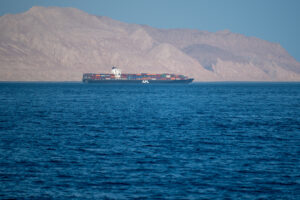
The Strait of Hormuz is one of the most significant strategic bottlenecks for maritime trade from the Middle East and is a central hub for shipping traffic.
Through it passes all the shipping traffic to and from the oil ports of Kuwait, Qatar, Bahrain, Iraq, the United Arab Emirates, and Iran, in addition to the largest part of Saudi Arabian traffic. Since a closure of the strait would block deliveries from significant parts of the oil regions in the Middle East (~1/5 of the global oil supply), it is of worldwide strategic importance.
Saudi Arabia ships 80 percent of its crude oil through the Strait of Hormuz, the Emirates about 65 percent. Qatar transports about 93 percent of its liquefied natural gas (LNG) this way. The situation is therefore devastating.
Two pipelines are trying to stand out as alternatives. Saudi Arabia operates the 1,200-kilometre-long "Petroline," which leads from the "Abqaiq" oil facility in the east through the desert to the port of Yanbu in the west on the Red Sea. Additionally, the Emirates have a 400-kilometre-long pipeline leading to the Gulf of Oman, which lies slightly away from the Strait of Hormuz.
These pipelines are intended to help redirect at least a portion of the oil. Additionally, the Sumed pipeline further north comes into play, which runs parallel to the Suez Canal in Egypt and connects the Red Sea with the Mediterranean. Tankers loading oil at the port of Yanbu could then bring it to the 320-kilometre-long Sumed pipeline and thus help bridge the supply crisis. For the gas from Qatar, the second-largest LNG exporter, there is currently no alternative to supply world markets.
Furthermore, the switch from ship to pipeline transport for crude oil is primarily a question of capacity and cost. According to the International Energy Agency (IEA), the pipelines in the region can transport only about a quarter of the approximately 20 million barrels of crude oil (159 litres each) that would otherwise be shipped on tankers. Lower volumes and high transport costs quickly become a problem here.
But the conflict affects not only the trade of oil and gas, but also the export of fertiliser. Around one-third of the world's shipped fertilisers normally pass through the Strait of Hormuz; the most important countries of origin are Qatar, Saudi Arabia, Bahrain, and Oman.
The Gulf region primarily exports urea, the most common type of nitrogen fertiliser, which is produced from natural gas and atmospheric nitrogen. But a significant portion of the world's traded phosphate fertilisers also originate from the Gulf states. Fertiliser production is very energy-intensive. In the Gulf region, there is plenty of inexpensive energy, primarily from natural gas and LNG. Due to soil conditions and water supply, the region is not particularly suitable for agriculture and therefore has little room for domestic utilisation of fertilisers, which is why the actors on the ground work primarily in an export-oriented manner.
Although the main buyers of fertilisers from the Gulf region are primarily countries in Africa and Asia, the effects are felt globally. The shortage of the global supply of fertiliser drives prices upward. Farmers are in some cases paying over 30 percent more than before the outbreak of war. An increase in fertiliser prices can, in the medium term, increase the prices of food.
Helium – The unsung casualty
Another victim of the conflict: helium. The noble gas is a by-product of the extraction and further processing of natural gas, and about one-third of the global supply has previously come from Qatar, the largest producer after the USA. The pharmaceutical and chemical industries, for example, suffer from this.
Helium is used in the pharmaceutical industry primarily for gas chromatographic quality controls, which are in many cases required by law. For this critical cross-sectional raw material, numerous countries are completely dependent on imports, a large part of which pass through the Strait of Hormuz.
The semiconductor industry is also affected. A considerable portion of the world's helium comes from Qatar; currently, it cannot be delivered. In semiconductor production, this is now having an impact.
Why this dilemma may be a historic lever for the biogas and bioenergy industry
The Gulf Wars of the 1980s and 1990s, the Ukraine conflict of 2022, and the current conflict in Iran in 2026 show how fragile global energy markets are and how massive the impacts are on a wide variety of industries that very few grasp in their entirety.
Without having to assess the conflicts politically, the bioenergy industry should look closely at the patterns, as interesting opportunities are arising for it, particularly in the United States and in Europe, and on several levels at once.
A brief look at the USA and the fertiliser situation there shows an enormous import dependency, which takes on similar characteristics in many areas of Europe as well.
According to the US Grain Transportation Report from April 10, 2025, on a nutrient-equivalent basis, the United States imported 5.8 million tons of nitrogen in 2024, 1.6 million tons of phosphorus, and 9.6 million tons of potassium. In 2024, the United States imported a total of 42.2 million tons of fertiliser commodities – that is up 7 percent from the average. The top commodities were potash (15.4 million tons); urea (5.2 million tons); sulfuric acid (3.9 million tons); phosphate rock (3.7 million tons); urea ammonium nitrate (UAN) (2.4 million tons); sulfur (2.3 million tons); diammonium phosphate (DAP) and monoammonium phosphate (MAP) (2.3 million tons); anhydrous ammonia (2.3 million tons); and ammonium sulfate (1.2 million tons).
Most of the world's potash reserves are located in Canada, Russia, and Belarus, which hold about 77% of global reserves. As a result, environmental, political, or infrastructural disruptions can directly affect potash availability and pricing. The US relies heavily on Canadian potash, importing about 85% of its supply due to the convenient border and integrated supply chain.
This is where biogas and bioenergy companies come into play.
Waste-to-energy concepts from organic waste and food scraps can serve as suppliers of compost and fertiliser. Residual materials remaining after the production of biogas can thus become valuable raw materials and strengthen the circular economy. Here, biogas and composting plants can open up an exciting sales market and serve it on a large scale, provided the raw material supply is secured.
But wood-fired power plants can also distribute wood ash as fertiliser. Wood ash has been used as a lime fertiliser for centuries. Using wood ash as fertiliser not only contributes to nutrient recycling, but can also replace many other sources of lime, phosphorus, and potassium, given the high prices of mineral fertilisers.
Furthermore, the energy and supply crises of recent decades have shown that numerous gaps in supply security exist. Here, the bioenergy lobby would have to become significantly more active and engage politically, for bioenergy can not only increase domestic supply security but also reduce dependency on imports and thus serve as a geopolitical instrument.
Countries with strong agriculture, large forests, and good disposal concepts in the area of waste wood and food waste can position themselves enormously strongly here and have the historical crises as a negotiating argument on their side.
But this is not the only advantage, for bioenergy has one thing over renewable energy: constant availability and thus flexibility.
If the bioenergy industry plays its cards right and politics is correspondingly willing, outstanding circular economy concepts could emerge that improve the thermal utilisation of waste materials, reduce imports, and increase the strategic expansion of the domestic energy supply.
With a view toward the manufacturing industries too, this would be highly sensible independent of the energy supply; for if the energy mix were to consist even more of bioenergy, the raw materials saved thereby could increasingly benefit the manufacturing industry.
If recent years have not shown that an energy mix as diverse as possible is not only financially and supply-technically, but above all geopolitically sensible and necessary, then what has?
And if politics does not play along, then eventually the economy will. Bioenergy companies should already be preparing their pitches to present themselves to industrial production companies – for example, to introduce steam, heat, and energy supply through their own bioenergy power plants, such as in the form of biogas or wood energy.
It is up to the bioenergy industry to become boldly active now.
The Strait of Hormuz in the context of the bioenergy industry