



← Go Back
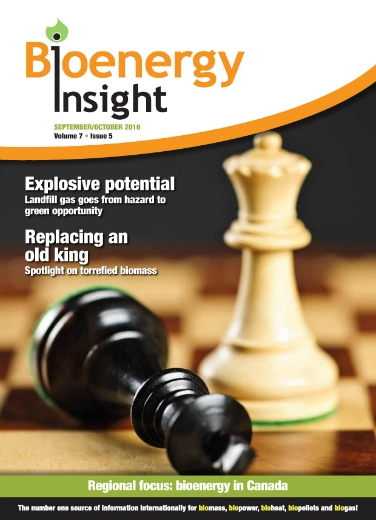
Volume 7, Issue 5
Sustainable solutions
Feature
The Intergovernmental Panel on Climate Change reviewed global energy scenarios in the context of CO2 stabilisation,and reported that by 2050, bioenergy (in replacement offossil fuels) should provide 80-150 Exajoules (EJ) per year to keep CO2eq concentration atabout 440–600ppm, and from118 to 190EJ for less than 440ppm CO2eq concentration.
Canada's biogas mission
Feature
Biogas is a small but growing industry in Canada. The production of Canadian biogas from all major sources —agricultural organics (excluding energy crops),landfill gas, residential and commercial source separated organics, and municipal wastewater — is equivalent to 3% of Canada’snatural gas demand or 2,420 million m3 per year of renewable natural gas.
From forest floor to green power
Feature
The use of forest biomass has increased significantly in recent years, supporting the growing bioeconomy across Canada. Traditional forest products companies have invested in increased use of biomass for steam and energy generation, the pellet sector has grown significantly, and some independent power producers use biomass as their feedstock.
It's getting hot in here
Feature
Biomass is increasingly being used as a fuel for power generation because it is sustainable and has the potential to be carbon-neutral in the medium term. In some cases, biomass is co-fired with coal, but a number of electricity generating units have been converted to run on 100% biomass.
Conifer fire starter
Feature
When Swede Robert Kraft took time out of his pharmaceutical career, he did not think he would stumble across a lightbulb moment. It all startedin Härnösand in northern Sweden when Kraft was in the middle of his three-yea rpaternity leave and wanted to find some outdoor activities to do with his children.
Size matters
Feature
Fuel wood markets across the globe are expanding. According to forestry analysts RISI, demand for biomass will likely triple by 2017, with Europe leading the way as a major consumer.Large-scale biomass power plants continue to go online around the world, but smaller scale biomass applications are also growing in popularity.
Rich rewards
Feature
Airex Energy is a supplier ofa torrefaction technology called the CarbonFX. This unique yet simple torrefaction process moved from being a proof of concept in 2010 to an industrial-scale technology in 2015. To prove to the market that this technology was ready for commercialisation, a fully integrated facility was built in the city of Becancour, Quebec, halfway between Montreal and Quebec City.
Replacing old 'King Coal'
Feature
Torrefaction is a thermal pre-treatmenttechnology used to upgrade lignocellulosic biomass toa higher quality and more attractive biofuel. In the torrefaction process, biomass is heated to a temperature between 250-350°C in an atmosphere with low oxygen concentrations, so that all moisture is removed.
The untapped potential
Feature
The UK’s first action plan for food waste was initiated andlaunched by the Waste and Resources Action Programme (WRAP)in July 2016. It aims to work with local authorities, food waste collectors and industr yto increase collaboration in order to improve the national proportion of food waste which iscollected and recycled.
Time for an upgrade
Feature
Injection of biomethane into the gas grid can face obstacles such as low-grid density or capacity issues. In 2012, France faced these challenges. This situation drove SIAAP, owner ofa major wastewater treatment plant in Valenton, Paris, and its site operator Suez to look for new solutions for valorising biogas. SIAAP treats water for an equivalent of 3 million inhabitants in the Paris area.
From farm to light bulb
Feature
Biomethane can be a significant additional revenue stream for farm operators. However, before itcan be fed into the Grid, it must conform to the samestandards as natural gas from any other source, and this requires on-site processing.
The mountains are alive with the sound of green music
Feature
Kompogas Winterthur AG is a Switzerland-based renewable energy company owned by the City of Winterthur and Axpo. In 2014, the company opened an anaerobic digestion (AD)plant. This plant processes around 23,000 tonnes of kitchen and green waste every year from more than 78,000 households based in the Swiss cities of Winterthur and Frauenfeld.
Trial and success
Feature
When it comes to anaerobic digestion (AD),trials canrange from making minor changes with the feedstock mix or dwell time to assessing the effects of major equipment upgrades, such as new combined heat and power (CHP) units or digestate processing equipment.
The journey of a thousand miles
Feature
Tuscor Lloyds has never been your typical logistics outfit, taking on some of the most difficult and in accessible work in the industry. When a UK biomass plant requireda door-to-door solution forits newly purchased biomass boiler, the projects team seized the challenge.
Turning over a new leaf
Feature
The intelligent reuse of wood is not a new phenomenon. As one of the world’s oldest materials, this sustainable resource has been proudly recycled and/or repurposed by mankind for thousands of years.But the wood processing landscape has continued to change extensively.
Explosive potential
Feature
Methane, a major constituent of landfill gas,came to the public eye in the late 1980s, when there were a number of explosions linked to the landfilling of biodegradable wastes. Probably the most high profile of these was the incident at Loscoe in Derbyshire, UK, in1986.
Cut and dry
Feature
Altentech isa privately held Canadian technology development company based in Vancouver,British Columbia (BC), Canada. Over the past nine years the company has successfully developed a new drying technology, the Biovertidryer 1.3. This game-changing technology provides many advantages to incumbent drying technologies being used in the bioenergy field and provides a means to add value to...
[read more]