



← Go Back
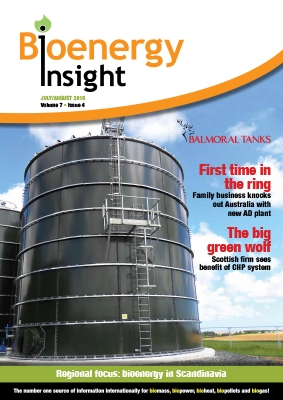
Volume 7, Issue 4
First time in the ring
Feature
At the official opening in March of Richgro’s newanaerobic digestion (AD) plant in Western Australia, managing director Geoff Richards looked out with immense pride and satisfaction. In the company’s centenary year, the new £3.5 million (€4.5m) AD plant represents a true cornerstone — not just for the family-owned and-run Richgro, but for Australia as a whole....
[read more]
Adding value to waste
Feature
Anaerobic digestion is a proven technology which can help play an important role in diverting waste from landfill. The renewable energy and recycling company Agrivert will deliver its seventh food waste AD plant in the UK this year, and the company has selected BWE Energie systeme to provide the plant’s technology. BWE, located inthe rural village of Friesoythein northwest Germany, was...
[read more]
All eyes on UK AD
Feature
The anaerobic digestion (AD)sector has gone from strength to strength in recent years. Growth has ultimately been driven by renewable energy incentives, making the investment into AD economical and financially secure for the long term.There are now 316 operational AD plants outside the water sector, which is a marked improvement on last year, when there were 234 plants.
The big green wolf
Feature
Gask Farm Biogas Plant, near Turriff in Aberdeenshire, UK,is an arable and pig farm run by John Rennie & Sons (Farmers), one of the few UK companies using an anaerobic digestion(AD) system to dispose of manufacturing food waste and slurries. The Rennie family have been involved in agricultural contracting and farming in the Turriff area in Aberdeenshire for four generations.
Precious steel
Feature
The city of Vechta in Germany is separated from Melbourne inAustralia by around16,000 kilometres. Currently one of the largest anaerobic digestion (AD )biogas plants using organic waste is being built down under. But in our global world large distances are no obstacle, and so it is not surprising that the entire tank and plant technology for the 1MW project comes from Germany.
The real work begins
Feature
Bioenergy progress across Scandinavia continues to be impressive as the different Nordic countries set increasingly ambitious targets for reducing their dependence on fossil fuels in their desire to limit future greenhouse gas (GHG) emissions. Denmark, Finland and Sweden have all increased their commitment to bioenergy in recent years. They have, for example, enabled the sector to become a...
[read more]
Clarity and confidence
Feature
Over the past few months, tense debates on the sustainability of biomass used for energy production have arisen. Most stakeholders seem to agree on one point:an EU policy to ensure the sustainability of biomass is required. It is needed to secure investments, to set a level playing field among member states, and to provide answers to questions and concerns from society on future bioenergy...
[read more]
Going for growth
Feature
The existing European waste legislation is in need of a significant revision.The EU’s CircularEconomy Package with a coming revision of the Waste Framework Directive, Landfill Directive and the Directive on Packaging Waste will focus on higher recycling targets(75% for packaging and 65% for municipal waste by 2030).It will also focus on a binding landfill target to reduce landfill to a...
[read more]
Power next door
Feature
A new massive biomass-fired combined heatand power (CHP) plant is an important step towards 100%renewable district heating in Stockholm, Sweden. The new plant, inaugurated in May and expected to commence commercial operation this autumn, has a heat production capacity equivalent to190,000 households and also produces electricity equivalent to 20,000 rooftops covered with solar panels.
Proofed for the future
Feature
In 2010, US-based company Astec began aggressively moving toward participating in the wood pellet industry as a manufacturer and supplier of wood pellet plantsand related equipment. At that time, the growth projections for the wood pellet industry were incomprehensible.There was practically a feeding frenzy of people trying to get a piece of this exploding business.
Plastics to power
Feature
Packaging is a necessary part of almost all products sold today. Laminate packaging is a very popular choice for its protective and lightweight attributes, but the multiple layers mean that there is no easy recycling route. As such, the packaging often ends up in landfill, wasting valuable raw resources. Now a new plant, based in Alconbury, UK, seeks to change that. Enval has developed and built...
[read more]
Clustering together
Feature
Canada is a country of abundant biomass from agriculture and forestry as well as municipal solidwaste (MSW). The country is seeing companies like biofuels producer Enerkem focus on MSW with a facility in Edmonton, Alberta. In relation to the forestry sector, there isa lot of research being done to determine the most effective utilisation of woody biomass. Today, companies involved inforestry are...
[read more]
King of the grass world
Feature
When one thinks of biomass energy, grass doesn’t automatically spring to mind. Images of burning wood or sugarcane bagasse normally permeate the brain. In fact, in most of the world, biomass energy means burning the latter. Wood and wood waste have many competing uses such as pulp and paper and construction materials. After Fukushima, Japan is also seeking wood pellets from around the...
[read more]
A decade of progress
Feature
Since Enviva was founded in 2004, it has had a clear, unchanging purpose.The company works to provide a cleaner energy alternative to coal. Enviva’s core product is, and always has been, sustainability. The company’s customers expect it. Regulators demand it. It is the reason why the group exists.Today Enviva is the world’s largest producer of wood pellets. In fact, last year...
[read more]