



← Go Back
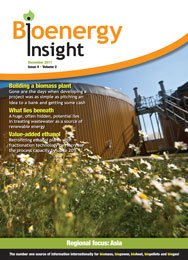
Volume 2, Issue 4
RHI fails to secure top tariff
Feature
The UK’s Renewable Heat Incentive (RHI) had its tariff for large-scale biomass heating dropped from £0.027 (€0.031) per KWh to £0.010 after the European Commission (EC) ruled it was too high. Initially the Department of Energy and Climate Change (DECC) had planned to put in place the RHI at the end of September but was forced to postpone after the EC said it was unhappy...
[read more]
The centre for certification
Feature
Following the high standards and market acceptance of the ENplus certification scheme for woodpellets that was introduced to the German market in 2010, the German Pellet Institute (DEPI) and the German Biomass Research Centre Leipzig (DBFZ) are developing a certification scheme for wood briquettes. This is based upon the new European Norm EN14961-3, which define schemical and physical parameters...
[read more]
Making the difference visible
Feature
Nine years ago the first certification body, Germany based DIN CERTCO, created certification for wood pellets and since then has been established as the leading wood pellet certification body. The idea behind the certification was to create an unambiguous and convincing guide and decision-making aid for pellet trade worldwide and help end consumers make the right decision when buying wood pellets...
[read more]
Standardising oil storage
Feature
Oil storage regulations are part of the devolved legislative framework within the UK. Wales, Scotland, Northern Ireland and England each have separate regulations that suppliers and distributors throughout the UK must abide by; these individual regulations can cause confusion and enforcement difficulties. In many instances companies may be inadvertently breaching oil storage regulations, thereby...
[read more]
Seeing the wood through the trees
Feature
Co-firing biomass pellets with coal in power utilities and industrial plants in Europe is widely practiced. European users have sourced their supplies fromRussia, eastern Europe, NorthAmerica, and Australasia. Asia on the other hand, isa very different market. Incontrast to European nations,the biomass industry in Asiais relatively nascent, both inthe production of biomassand in the usage of...
[read more]
Pellet potential
Feature
Almost 94% of biomass produced in Malaysia comes from oil palm, while wood waste accounts for up to 4% with the remaining coming from rice and sugarcane residues. The fact that crude palm oil is Malaysia’s largest export comes as no surprise. Around 20,000 palm kernel shells (PKS) are exported to other countries every year. Locally, PKS are used by the world leader of building materials,...
[read more]