




← Go Back
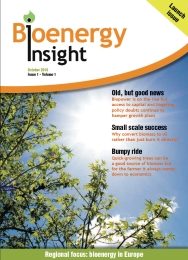
Volume 1, Issue 1
The big green Finnish machine
Feature
Finland was voted number one country in the world in a Newsweek poll in August and now thanks to a new biogas partnership the little-known Baltic country is poised to become a leading bioenergy producer. With a national population lower than the city of London, UK, there is an abundance of land to feed renewable projects. Twenty farms in the Turku area in southwest Finland helped form Biovakka as...
[read more]
The UK’s biomass pioneer
Feature
With the North Sea linking it to mainland Europe, and the expanse of the Atlantic Sea linking it to the Americas, the UK is ideally positioned on the global biomass distribution map. From biomass power, to tidal power and wind power – investors have an array of renewable options to choose from on an island. The UK government states that all onshore wind and onshore landfill gas projects have been...
[read more]
Reinventing the mills
Feature
Pulp and paper companies, which are closing mills as the industry consolidates, are creating opportunities for biofuel, biomass-to-power and pellet producers trying to commercialise their technologies. Biomass users planning greenfi eld facilities could signifi cantly reduce capital costs by converting these former mills into brownfi eld assets. Many mills already use biomass as an energy source....
[read more]
Old but good news
Feature
‘The problem with bioenergy is not that it is new. It has been around forever so its significance is very underestimated.’ That is the view of one Brussels-based renewable energy expert, who despairs at the way wind and solar tend to hog the headlines. And headlines translate into investment – something which is crucial when it comes to meeting Europe’s ambitious 20% renewable energy target for...
[read more]
Bumpy ride
Feature
Research into the short rotation tree crops willow and poplar has been going for more than 20 years, looking at the agronomy, handling, drying and how to use and convert the wood chips most effectively. Some countries have given up and have opted for perennial grasses but there are signs that in selected markets the tree crops are now gaining a foothold as a reliable source of biomass energy....
[read more]
Barriers and opportunities for solid biomass trade
Feature
International trade of both solid bioenergy commodities has grown rapidly over the past few years. The most prominent example is wood pellets: in 2008 roughly 11.8 million tonnes were consumed worldwide and probably over one third of this amount was traded over a border. Trade routes differ greatly, for example from Canada and the US to the Netherlands, Belgium and the UK in large Panamax...
[read more]
Handle with care
Feature
Europe has vigorously promoted biomass as an alternative fuel but does not have sufficient sources of woody biomass. As a contrast, Canada has a tremendous amount of woody biomass. For decades residual wastewood has been well-used as a fuel source for industrial plants. However, there is little incentive in Canada to use standing forests for fuel as there is such a small population, and an...
[read more]
Inspiring others
Feature
With the escalation of landfill tax, a growing emphasis on recycling and recovery, new government incentives to encourage renewable energy from waste, and innovative new technologies coming on stream, the opportunities for small and medium sized waste contractors have never been greater. Nowhere is this truer than in the area of commercial and industrial waste, where the volumes being generated...
[read more]
Call all biomass be treated equal?
Feature
Referred to by some as the fourth energy source, biomass undoubtedly has the potential to contribute towards reducing the world’s dependency on fossil fuels. However not all types of organic material are equal and available in abundant quantities and at the moment existing energy policy does not recognise this. Wood is a case in point. As a fuel it is attractive because it has a calorific value...
[read more]
Small scale success
Feature
Pyrolysis is the production of gases, liquids, and char (solid residue) by thermal decomposition of an organic compound in the absence of oxygen. The liquid produced from pyrolysis of biomass used to be referred to as bio-oil or sometimes biocrude but pyrolysis oil (PO) is now preferred and the properties of the oil are defined by ASTM D7544 - 09 Standard Specification for Pyrolysis Liquid...
[read more]
A steamy solution
Feature
The hunter has spent most of the summer by the lakes, but now autumn’s chill is advancing. After a long day of fi shing he gathers some wood for the evening fi re. He sets aside his fi sh, a good catch, when he realises he is cold. Lighting this fi re now has a sense of urgency about it – he needs the heat not only for his food, but potentially to stave off hypothermia in the wilderness. He...
[read more]
Mixed not stirred
Feature
Anaerobic digestion is used to treat a number of different waste streams including municipal solid wastes, sewage sludge and farm waste matter. During the breakdown of these materials two by-products are produced: digestate and biogas. While digestate can be used as an organic fertiliser for the land, the biogas, which is made up of approximately 60% methane and 40% carbon dioxide (CO2), can be...
[read more]
One man's trash is another's treasure
Feature
Although efficient in dealing with waste, there is no escaping the fact that landfill sites are an eyesore. In 2006 landfills were the second-largest source of manmade methane, producing over 22% of the total output. When the waste dumped at landfills begins to decompose through the process of anaerobic digestion, landfill gas (LFG) is produced. LFG consists of about 40-60% methane, with the...
[read more]
The pellet mill with a ring to it
Feature
In 2009 global production of wood pellets reached around 10-11 million tonnes, with players such as Denmark-based pellet mill provider Andritz Feed & Biofuel seeing a growth rate in excess of 20% a year. Now with the industry branching out from traditional sawdust to new raw materials such as straw and energy grasses, effi cient technology is in demand. Pellets have long been used as home heating...
[read more]
Moving on air
Feature
Money does not grow on trees, but there is money to be made from trees. However in today’s fragile economy even a booming industry like bioenergy needs to watch the pennies. Mechanical faults, loss of product and hazards such as explosion and fires at a facility all mean extra costs for downtime and maintenance. These are considerations to bear in mind when selecting a conveyor system, a range of...
[read more]