




← Go Back
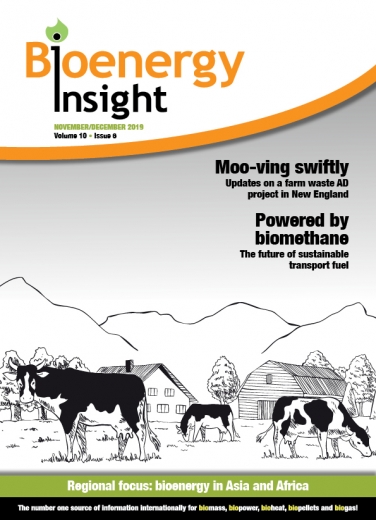
Volume 10, Issue 6
The fight to realise biogas' potential in achieving net zero
Feature
On 22-23 October, Bioenergy Insight held its annual conference, incorporating three key events: the Biogas Congress & Expo, Biomass Congress & Expo and Biofuels International Conference & Expo. A fantastic line-up of key speakers and more than 200 delegates from all over the world gathered at the grand Hotel Le Plaza in Brussels to discuss the latest trends in bioenergy and biofuels.
Collaborating with US farmers to help the environment
Feature
Across the US, dairy farmers are working with renewable energy companies to make use of what would otherwise go to waste. Dairy, food, animal and other organic waste is being converted into biogas with the help of companies like Brightmark Energy, to generate heat, electricity and support farming communities.
Biomethane as a sustainable transport fuel
Feature
Biomethane demonstrates enormous potential as an environmentally friendly transport fuel. A recent study by IFPEN (IFP Energies nouvelles, the French Institute of Petroleum) found that biomethane-fuelled cars are the best transportation option to preserve air quality.
Asia and renewable energy - the only viable option for a sustainable future
Feature
It’s pretty much impossible to overstate the importance of Asia in terms of its current and future role in renewable energy development. The region contains more than half the world’s population and has been calculated to account for 45% of all global CO2 emissions.
The future of waste management
Feature
Commercial waste, organic waste, coloured glass, clear glass, metal, paper and light packaging: the seven different waste containers in front of Komptech headquarters in Frohnleiten, Austria often provoke amazement, as well as reflection.
Plant nursery goes above and beyond with air quality monitoring project
Feature
Many environmental consultants have found that there are several flue gas dust abatement techniques available on the market today. One which ticks all the boxes has been installed at a UK strawberry farm nursery, while also making significant cost savings and reducing the impact on the environment.
Maximising biomethane production efficiency using advanced automation technology
Feature
Biomethane presents a great new opportunity for Europe as a low-cost, eco friendly form of energy and the market for this productis growing rapidly. New regulations within many European countries not only enable biomethane to be added to the natural gas networks, but incentives are also available to increase the amount of biomethane added to the grid.
Moo-ving swiftly - updates on a farm waste AD project in New England
Feature
Agricultural waste has huge potential in the biogas sector. One of the latest projects in the US utilising farm waste is collaboration between organics to energy company, a local farm, a local college and a clean energy firm.
Wood waste drying - effective solutions
Feature
Dryness in many European countries and the parallel expansion of the bark beetle population makes European forests suffer. Large forest grounds have to be replanted. So, what should we do with the dead wood and the bark beetle-polluted wood?
First-person sleuthing, broken mixer in digester tank
Feature
Torsten Fischer, founder and managing director at Krieg + Fischer Ingenieure, has been an expert legal witness for more than 10 years, covering 120 cases, and wrote his first report about a biogas plant accident more than 15 years ago.
Alternatives to storing biomass in vertical silos
Feature
Vertical silos are ubiquitous across many industries. For storing biomass, however, they’re hardly ideal. Biomass does not flow well, and it’s a challenge to modify vertical silos to handle it effectively. Because of these issues, companies that store biomass may benefit from placing the material in horizontal silos or on slabs with moving floors.
Waste wood imports from Europe to UK likely, says WRA
Feature
The UK is experiencing a surge in new biomass plants coming into operation. While this is excellent news for the industry, conversations are underway to guarantee waste wood supplies to keep up with growing demand. Bioenergy Insight spoke to Andy Hill, chair of the Wood Recyclers’ Association (WRA), to find out more.