



← Go Back
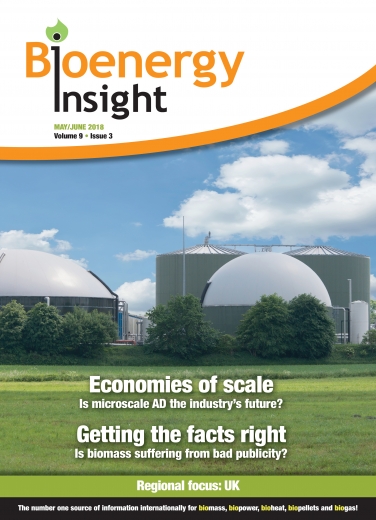
Volume 9, Issue 3
Economies of scale
Feature
UK based Qube Renewables manufactures microscale anaerobic digestion units for onsite waste treatment for localised embedded energy generation. The company’s technology has been used in a range of applications, including remote communities and NGO or military operations. Here, Bioenergy Insight speaks with the company’s technical director and co-founder, Mark Clayton, about the...
[read more]
Anaerobic digestion and the future of the cheeseburger
Feature
Dr David Kaner, Chief Executive of Advanced Anaerobics, believes that dairy farmers in the UK will be purchasing AD plants in 2020 and beyond, but that the reasons for purchase will be different from today. A new generation of technologies will deliver broader economic and environmental benefits that may, in turn, improve the future sustainability of the cheeseburger and the milkshake.
Embracing the circular economy
Feature
The past year has been challenging for the bioenergy sector,with continued uncertainty about future policy and endless delays over the resetting of RHI first indicated in late 2016. Sooner than might have been anticipated, the biogas industry now needs to adapt to an era with lower or even no incentives. Companies that remain active in Britain’s anaerobic digestion sector and their...
[read more]
Ireland's landmark AD plant continues to set standards
Feature
Unlike the UK with its Feed-In-Tariffs (FITs), there was no such incentive in 2010 in the Republic of Ireland — but determined to diversify and to continue to take its farm forward, the McDonnell family decided to go ahead with using both its dairy herd and poultry manure to produce biogas. The McDonnells had the vision — and had more than done their homework. They’d had...
[read more]
How to prevent a global food crisis
Feature
A global food crisis may be threatening the world within the next 30-50 years. World population is expected to increase by around 2.5 billion people, and the need for food will rise accordingly. During the same period of time, scarcity of phosphorus could lead to a global crisis in food supply due to lack of fertilisers and sky-rocketing phosphorus prices. No plants can grow without phosphorus,...
[read more]
Driving with feathers
Feature
The global production of chicken meat is growing and seems set to continue doing so. But chickens are not without feathers and these are mostly considered as waste. There are millions of tonnes of feathers around the world. Although there are a number of products made from chicken feathers, like feather meal, diapers, fibres, biodiesel and biogas, many producers have a problem with feather waste...
[read more]
A step closer to energy neutrality
Feature
For decades, wastewater treatment facilities have employed anaerobic digestion technologies to reduce and stabilise solids in sewage sludge. Microorganisms break down biodegradable material during a multi-phased biological process, creating end products that are typically disposed of, or in the case of biosolids, destined for land application or composting. Increasing pressure to be energy...
[read more]
Connecting up the green gas revolution
Feature
It may have escaped the attention of many but over the past couple of years the UK Government has made significant moves away from hoping heat can be provided by electricity to seriously considering the potential offered by Britain’s extensive, efficient and reliable gas network. A classic example of ‘out of sight, out of mind’, the gas network is so successful that even in the...
[read more]
Igniting biogas growth in the UK and beyond
Feature
Charlotte Morton, chief executive of the Anaerobic Digestion & Bioresources Association, gives a preview of what to expect at UK AD & World Biogas Expo 2018.
Keep moving
Feature
A well-known business adage that bears the test of time is: ‘If you stand still, you are dead’. Looking back at the last 30 years of our industry it is fair to say that the supply chain bandwagon has been well and truly loaded with uninspired, pedestrian business models. Balmoral has previously written about what world class and responsible manufacturing and contracting actually...
[read more]
Digitalisation - the industrial game changer
Feature
Digitalisation is the technology focus behind Industry 4.0 — a term that while widely used, is perhaps not yet totally understood. At the heart of Industry 4.0 lies a highly digitalised industrial landscape which promises a data-rich interconnected world; one where seamless technology platforms will help improve productivity, promote flexible production capability, create high value jobs,...
[read more]
Context is key
Feature
If environmentalists have a collective original sin, a tendency for internecine warfare must top the list. It was one of the reasons for the founding of the Renewable Energy Association, the umbrella body for Biomass UK, which I represent. Bringing different technologies together was crucial to making the case for all renewables and to push climate change up the agenda in the UK. And that unified...
[read more]
Getting the most from biomass
Feature
To keep the UK on a trajectory for scaling up domestic biomass production out to the 2050s, the country will need to make more productive use of its arable land through the planting of second generation crops. The market for energy crops is promising but faces both technical and market barriers. To support investment decisions, new research findings from the Energy Technologies Institute (ETI)...
[read more]
In tight supply
Feature
Wood pellet suppliers and distributors to the UK market have endured a tough start to 2018, being required to cope with severe raw material shortages in January and still being faced with a tighter supply position than usual as they head into the summer sales season. Adding insult to injury, some of those who invested heavily in expensive January pellets to keep customers happy at the time, are...
[read more]
Accelerated process
Feature
For the last 10 years, Don Fosnacht, associate director of the National Resources Research Institute (NRRI) at the University of Minnesota Duluth (UMD) has been on a quest to develop a coal substitute that’s made from roasted wood. While the world continues to eliminate coal-burning power plants and phase out internal combustion engines for new cars, Fosnacht says it will take years, even...
[read more]
Switching feedstocks - from wood to waste
Feature
Gasification technology has an important role to play in tackling two of the big issues facing society today — how to reduce the mountains of waste and meet our energy needs in an environmentally-friendly way. By heating waste — or other combustible materials — to high temperatures and converting them into a gas (“syngas”) that can be used as a fuel, the process can...
[read more]
Moving with the times
Feature
Stora Enso is one of the oldest companies in the world. Its written history dates from the year 1288, when the bishop of Västerås received one eighth of the Stora Kopparberg in Falun, Sweden, which had been a copper mine for half a century. In the 1970s, Stora sold its mining and metal business and began concentrating solely on the forestry, pulp and paper sectors. As for Enso —...
[read more]