



← Go Back
Volume 7, Issue 3
Building a world-class AD industry
Feature
This year’s UK AD& Biogas expo on 6-7 July at the NEC, Birmingham,will be Anaerobic Digestion & Bioresources Association (ADBA)’s seventh international trade show. It firmly establishes the role the industry can play in the global economy, helping to address some of the world’s most pressing challenges,and the UK industry’s place at the crest of this technological...
[read more]
On-site AD desperately needs the "right kind of support"
Feature
On-site anaerobicdigestion (AD) has agood future ahead of it provided thesector is given the “right kind of support”, says the Anaerobic Digestion & Bioresources Association (ADBA). Unfortunately, those most closely involved in the sector do not believe that the right kind of support is being provided at present or that there are sufficient signs of better support being given in...
[read more]
The Big Question
Feature
YES. The latest round of feed-in tariffdegressions, which took place on 31 March, saw a significant reduction in subsidies for anaerobic digestion(AD) sites. Specifically, the tariff for facilities under 500kW reduced from 10.54 to 9.36p/kWh, while the rate for facilities greater than 500kW dropped from 9.16 to 8.68p/kWh.
New Hertfordshire AD plant boosts Britain's food waste recycling credentials
Feature
Commercial and industrial food processors in Hertfordshire and Essex, in the UK,now have a greener, cheaper option for managing food waste, with the opening ofa new anaerobic digestion(AD) plant in Hoddesdon. Food and green waste recycling company Tamar Energy has added another link to its network and opened its fifth AD plant. The latest 3MW Hoddesdon facility has just come online and will...
[read more]
Challenges of building AD plants
Feature
In all construction and engineering industries, there are always challenges when it comes to building. The anaerobic digestion (AD) industry is no exception to the obstacles that occur throughout the construction process. The challenges that the AD sector faces when building AD plantsdoes not just occur during the design and construction phase, but before the process begins and after ithas been...
[read more]
The forgotten element
Feature
Anaerobic digestion(AD) produces many valuable and useful products, including biogas (which can then be turned into heat, electricity,or biomethane gas) and digestate, a biofertiliser rich in nutrients and organic matter. However, many farm AD plants also produce incidental heat, which can be captured and used within the AD process or for other on-site operations.
Adding value to packaged food waste
Feature
Packaged food waste is a valuable commoditya nd a rich source of material for anaerobic digestion(AD) plants. The main foodstuff materials available are packaged supermarket waste and kerbside-collectedkitchen waste, which generally arrives in biodegradable starch bags, which pose their own problems to AD. If not removed, they wrap around mixers, block pumps and screw conveyors, and take up...
[read more]
Gas holder of choice
Feature
Recently the expression “AD ”has been used increasingly to refer only to agricultural waste anaerobic digestion schemes. But anaerobicdigestion has been in use since as early as 1895 in the municipal water industry— albeit its extensive use was introduced considerably later — and it is here in the municipal wastewater sector that AD has found its greatest application.
Powered by cheese: Norfolk-based farm enjoys energy boom
Feature
Faced with ananaerobic digestion(AD) plant not operating effectively, Stephen Temple — a Norfolk-based dairy farmer and co-owner of Mrs Temple’sCheeses — enlisted the help of CooperOstlund to give him advice on a new engine solution to turn unwanted waste into renewable energy. Installed and commissioned in less than 48 hours, the140kW system now generates more than...
[read more]
Chip off the old block
Feature
During 2015 Statkraft turned a former pulp mill site, based in Tofte, Norway, into a new wood chip trading “hub”. Located close to Scandinavian customers, with 35 hectaresof storage and deep water berths capable of receiving panama-sized wood chip carriers, the Tofte site is an ideal opportunity for the company to expand its biomass trading operations.
Rethinking cleaning
Feature
Over the past few years, there has been an enormous change in the power sector. Renewables have grown in popularity in the UK, with wind farms and solar panels appearing and biomass replacing that old stalwart coal. Biomass(waste wood, wood pellets,wood chips, and straw) ismaking a big impact on themarket, both domesticallyand on an industrial scale. The various subsidies are obviously a strong...
[read more]
Biomass boiler upgrades to boost power generation
Feature
Most energy intensive manufacturing facilities that use large amounts of steam and power (e.g., pulp, forest, and food products plants) operate industrial boilers to providelow-pressure saturated steam (typically at between 345kPa and 1380kPa) for the manufacturing process. Byfirst generating superheated steam at high temperature and pressure and passing the steam through either back pressure or...
[read more]
Obtaining environmental compliance with existing assets
Feature
The industrial biomass-fired boiler market has a number of mature installations from the1970s, 1980s, and 1990s. New or impending environmental legislation and rules are forcing these 20- and 40-year-old facilities to evaluate their operations for both efficiency and environmental compliance. Nations throughout the world have or are currently developing a number of new regulations for biomass...
[read more]
Farm power
Feature
JS Baird is a family run farm of mixed arable, livestock,broiler chickens and laying hens set over 600 acres. The farm produces eggs, wheat, lamb,beef, and wheat. With a history of diversification and innovation the farm is attempting to bridge the gap between farming and energy.
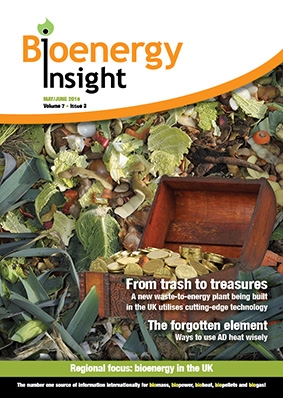
From trash to treasures
Feature
For more than a decade, Dong Energy has been active in the UK offshore wind sector, providing increasing amounts of renewable energy for the UK, investing billions of pounds and employing a growing workforce. Due to this, it is fair to say that more people associate Dong with wind turbines than waste.
Powering ahead
Feature
In this day and age there is a need to look at alternative ways to create much needed low carbon and renewable energy. It is only in the past few years that the opportunities from biogas have become more apparent to a broader audience. Looking at the massive potential of it, it becomes clear iti s a valuable fuel for the creation of renewable energy for now and in the future.
Unlocking waste wood potential
Feature
In waste management systems, waste wood is collected separately for subsequent material or thermal use. The term“waste wood” covers materials with very different qualities. Distinctions can be defined by legal, material-related or process-related criteria. In Austria, most waste wood streams count legally as waste. Processing-related parameter sfor quality assessment include material...
[read more]
Briquetting solid waste
Feature
The European Waste Directive set targets for each EU member country to reduce the mass of waste consigned to landfill. Encouraged by regulation and the landfill tax, UK waste producers and processor swere motivated to “reduce,reuse, and recycle”. Processing technology has enabled waste pre-treatment and recovery of aggregates, glass, metals,plastic, paper, and cardboard.
Charting a course towards a bio-based future
Feature
Global challenges like climate change, resource scarcity and population growth mean companies need to learn to do more with less and use raw materials more efficiently. On top of this,pulp and paper companies face the added problem ofd eclining paper use, resulting from a shift to digital. To tackle these issues, Stora Enso,a leading manufacturer of pulp, paper, board and wood products, is...
[read more]
EBA conference 2016 focuses on 'greening gas'
Feature
The Conference of the European Biogas Association (EBA) is its most important event. The upcoming conference will revolve around biogas, syngas, and biomethane production, along with digestate, biorefineries, and sustainable raw materials supply. Current debates on the EU level, such as next Renewable Energy Directive and future of biowaste within the circular economy will be reflectedby a...
[read more]
Delivering a message
Feature
A round table entitled Fact vs Myth — How to rewrite the bioenergy narrative took place recently in the framework of the 2016 Argus conference in London, UK. The fact that communication issues are now under the spotlight of one of the leading sectorial business conferences, under such an evocative title, speaks volumes about the challenges ahead.
Future-proofing biomass plants
Feature
Biomass plant engineers use the most efficient technology to maximise power production and plant reliability. They also need to use the best available techniques when designing,for example, the flue gas treatment system; and yetsome flexibility is required to accommodate changing feedstock and future regulatory conditions that will demand even lower emission limit values (ELVs).