



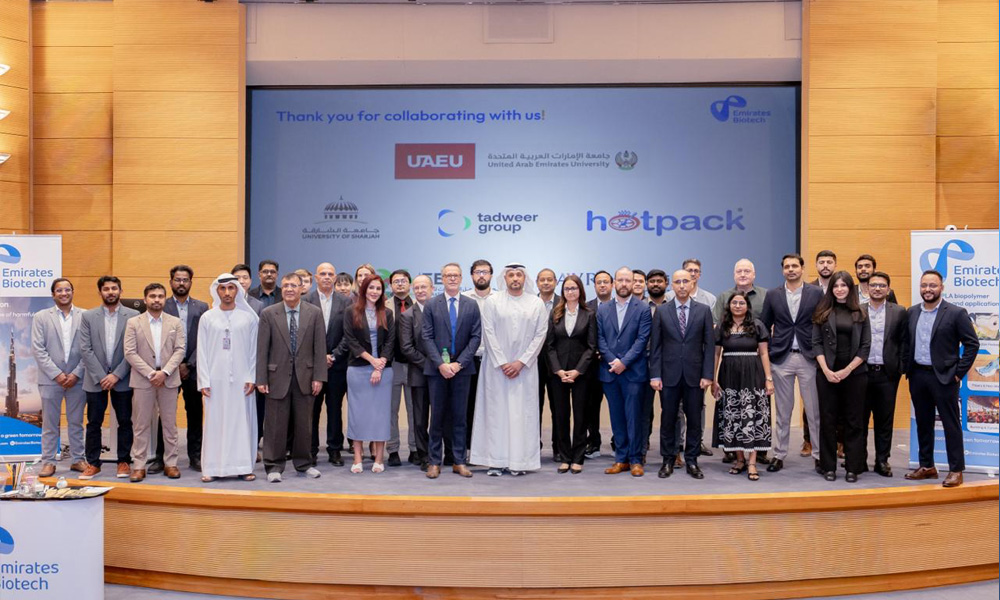
Emirates Biotech and United Arab Emirates University (UAEU) are to build and operate what they describe as the country's first integrated organic-waste valorisation pilot plant, a research project aimed at turning food waste and compostable packaging into biogas and compost.
The partnership was launched at UAEU's campus in Al Ain, with stakeholders from across the waste and sustainability value chains in attendance. The pilot facility will be sited close to the campus and will process up to 40kg of organic waste a day, a deliberately small scale given that the main aim is to produce technical and operational guidelines that could support wider rollout in the UAE and beyond.
The project responds to a significant local waste challenge. Food waste accounts for nearly 40 per cent of the UAE's daily municipal solid waste, and much of it ends up in landfill. Conventional plastic packaging contaminated with food residue is also hard to recycle, so the team will test whether food waste and compostable packaging can be processed together, recovering resources while keeping material out of landfill.
The plant will pair anaerobic digestion with composting. Digestion will convert the waste into biogas, while the remaining digestate will be composted into a nutrient-rich soil product. Over the two-year project, researchers will assess the process's technical performance, environmental impact and economic viability. Installation and commissioning are scheduled for completion by August 2027.
A laboratory-scale study will also examine whether the biogas could be converted into renewable hydrogen. Emirates Biotech chief technology officer Dr Aman Kulshrestha described the project as a novel integrated biorefinery concept for organic waste management in the UAE, adding that successful regional validation could change how the country approaches organic waste diversion and circularity, and show the role compostable packaging can play in enabling it.
UAEU project lead Professor Zafar Said Sher said the pilot would evaluate a practical end-of-life route for food waste and compostable packaging while supporting the UAE's circular economy, food security and net zero ambitions. Students and researchers will take part in the work, giving the university a platform for training and for building local capability in waste-to-resource technologies. UAEU's Associate Provost for Research, Dr Rami, said the collaboration showed how academic research could be turned into practical, scalable solutions.
The partners say a full-scale integrated plant could cut CO₂ emissions by 89 per cent compared with landfilling. By generating validated technical evidence, the project aims to produce a modular, scalable roadmap for converting food waste and compostable packaging into renewable biogas and compost.