





Cadent, the UK's largest gas distribution network, has confirmed that the total volume of biomethane injected into its pipelines since 2013 has now exceeded 1.5 billion cubic metres.
The figure marks a significant moment for the UK's green gas sector. In energy terms, the volume delivered to date is equivalent to heating around 1.5 million homes for a year, or every household in Leicestershire for five years.
It represents an estimated three million tonnes of CO₂ avoided compared with the use of natural gas — the same as taking 750,000 cars off the road for a year.
Cadent's networks have an installed capacity of around 4TWh of biomethane — equivalent to the annual gas usage of 351,000 homes — and the company has set a target to scale this to 20TWh by 2035, enough to supply approximately 1.8 million homes.
With over 80,000 miles of pipeline supplying homes, businesses, public services and energy-intensive industries, Cadent says its network is well placed to help biomethane scale rapidly in support of the UK's net zero ambitions.
The milestone coincides with a deadline for biomethane developers to apply for a share of reinforcement costs associated with connecting new plants to the gas network.
Cadent recently introduced a new Entry Reinforcement Assessment Window following changes to industry rules on how such costs are distributed. The window closed on 6 March 2026.
Under previous arrangements, the first project in an area requiring network reinforcement bore the full cost of upgrading local infrastructure — a barrier frequently cited by developers.
Cadent's updated process assesses planned projects in clusters and apportions reinforcement costs on a shared basis.
Howard Forster, Chief Operating Officer at Cadent, said: "Biomethane is one of the fastest, most cost-effective ways to decarbonise heat today. But the industry has been held back by outdated charging rules that placed the entire reinforcement burden on individual developers.
"This new process — the first of its kind in our industry — moves away from the 'first-connector pays' principle and creates a fairer, more customer-centric path for biomethane projects to connect.
"By clustering applications and sharing reinforcement costs, we're helping unlock the next wave of biomethane growth across our networks."
There are currently 47 biomethane plants connected to Cadent's network, which covers the North West, South Yorkshire, the East and West Midlands, the East of England and North London. The first plant was connected in 2013.
Cadent hits 1.5 billion cubic metre milestone in UK biomethane push
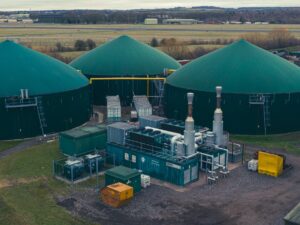
Credit: Severn Trent Green Power
Credit: Severn Trent Green Power