





Ireland's agricultural sector is sitting on an untapped opportunity to transform livestock waste into renewable energy, but the absence of targeted government support is preventing small-scale biogas systems from becoming mainstream.
This is according to Barry Caslin, Teagasc Energy and Rural Development Specialist, writing with contributions from Dr Shaun Connolly, Research Officer at Teagasc Johnstown Castle, and Dr Adriana Ferreira Maluf Braga, Research Technologist at Teagasc Grange.
With approximately 40 million tonnes of livestock waste produced annually across Irish farms, the potential for anaerobic digestion technology is substantial.
Yet Ireland currently operates just 31 biogas plants, including only 10 that process animal by-products. This stands in stark contrast to the European Union as a whole, where roughly 21,100 anaerobic digester facilities are in operation, with agricultural sources accounting for an estimated 67% of biogas output.
The disparity is even more apparent when compared to the UK, where around 427 on-farm anaerobic digestion plants are currently functioning, with 79 running exclusively on livestock manures.
Financial viability remains elusive
Despite the benefits, the economics of small-scale anaerobic digestion remain challenging without government intervention. Analysis of a 44-kilowatt electrical capacity plant suitable for a 300-cow dairy farm reveals the scale of the problem.
Such a system would cost approximately €450,000 to install and generate 354,640 kilowatt-hours of electricity annually, assuming 92% operational capacity. With farm annual consumption at 146,000 kilowatt-hours, valued at €0.35 per kilowatt-hour when displacing purchased electricity, and exported electricity fetching €0.20 per kilowatt-hour, total annual revenue would reach €105,148 when including heat usage and digestate value.
However, total annual costs amount to €115,800, including operating expenses of €52,800 and a capital charge of €63,000 based on a 14% required return on investment. The result is a system that cannot achieve payback without additional financial support.
To reach break-even, the plant would need an average electricity price of €0.33 per kilowatt-hour, significantly higher than current export rates.
Government support proves decisive elsewhere
International experience demonstrates that government backing is the primary driver for biogas plant construction worldwide. Successful programmes have employed various mechanisms including feed-in tariffs, renewable heat support schemes, capital grants, green gas certificates, contracts for difference, and technical assistance.
Current Irish support focuses predominantly on large-scale biomethane plants, leaving smaller operations at a disadvantage. Energy specialists suggest that future support schemes based on carbon savings, rather than solely on energy generation, could make small-scale anaerobic digestion more competitive.
Market pressures mounting
Growing pressure from milk buyers and retailers regarding sustainability credentials is creating renewed interest in the technology. Some international initiatives already offer premiums for milk produced with lower carbon footprints, including through anaerobic digestion.
The Arla FarmAhead scheme in the UK provides one example of how dairy processors can incentivise adoption whilst gaining marketing advantages. As carbon labelling becomes more widespread across the EU, Irish dairy cooperatives could potentially follow similar approaches.
Suitability and scale considerations
Anaerobic digestion plants are designed for continuous operation, requiring reliable feedstock supplies and steady on-site energy demand. Systems are typically most suitable for farms with at least 120 cows housed year-round.
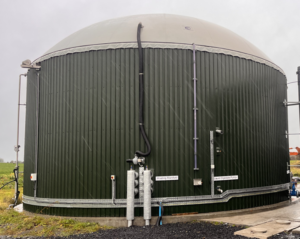
Farm-scale units are often modular, with capacities ranging from 11 to 74 kilowatts and costs between €250,000 and €550,000. Some employ traditional round reactors for improved fermentation, whilst others capture gases from existing sealed slurry stores.
Proper sizing is crucial, as oversized systems can lead to operational problems if feedstock supply is insufficient. Using self-generated electricity on-site proves far more profitable than grid export, making on-farm energy demand a key consideration.
Additional challenges
Grid connection requirements can present obstacles even when most electricity is consumed on-site, necessitating early engagement with network operators. Planning permission is required for all developments, though concerns about traffic and odour are generally more relevant to larger facilities.
The technology is unsuitable for farms where cattle are bedded on sand, due to equipment abrasion and sediment buildup. Environmental regulations require low-emission application methods for digestate, such as trailing shoe or direct soil injection, rather than splash-plate spreading.
Sector-level potential
Widespread adoption of anaerobic digestion could reduce emissions from European livestock farming by millions of tonnes annually, supporting the transition towards climate neutrality across agriculture, energy, and food supply chains.
The benefits extend beyond climate mitigation to include improved air quality, reduced odour, and support for a circular, low-carbon rural economy. Both the Food and Agriculture Organisation and the Intergovernmental Panel on Climate Change have recognised these wider advantages.
However, realising this potential will require policy frameworks that acknowledge the full range of benefits small-scale anaerobic digestion delivers, rather than focusing solely on energy generation metrics.
Small-scale biogas systems need greater support, experts say