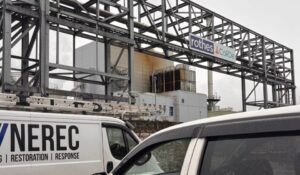






A decade’s worth of harsh weather, whisky mould and industrial wear has been stripped away from the Rothes CoRDe facility following a major restoration project carried out by specialist cleaning contractor NEREC Ltd.
The plant, which opened in 2013, had never undergone a full exterior clean.
Years of exposure to Speyside’s damp climate, combined with chlorinated processes on site, had left buildings heavily stained with rust, coated in black whisky mould and affected by widespread surface contamination.
According to the maintenance team, the goal went far beyond cosmetic improvement: they needed the site restored to near-original condition to prevent long-term material damage and avoid costly future replacements.
NEREC was commissioned to deliver a full-scale restoration across the active facility. This would involve complex access requirements, specialist cleaning techniques and coordination with operations to ensure production remained uninterrupted.
A challenging worksite
Accessing structures at height and reaching narrow spaces between live equipment meant standard methods were insufficient.
Flexible approaches were needed to avoid interrupting vehicle movements and safety systems.
The team also faced persistent whisky mould — the fungus Baudoinia compniacensis, notorious in distillery environments for its thick black growth and resistance to normal cleaning — as well as extensive rust caused by environmental exposure and chemicals used on site.
Windy weather further compounded the challenge, often forcing delays to high-access work.
Despite this, the restoration was completed without a single safety incident.
Strategic approach
Managing director Andrew Bruce led an in-depth ground survey to map the scope of work.
With drone inspections ruled out, detailed on-foot assessment guided the planning of a phased programme that balanced operational needs with safety.
Two cherry pickers — one compact machine for confined areas and a larger unit for elevated structures — were deployed to navigate the site efficiently.
Work at height was scheduled around plant deliveries and shift changes to prevent disruption.
To tackle whisky mould, NEREC used a two-stage removal strategy: a professional antifungal biocide to break down the fungus and kill spores, followed by carefully calibrated pressure washing or steam cleaning depending on surface sensitivity.
Rust removal required a tailored approach, ranging from soft washing with specialist dissolvers on delicate materials to controlled pressure washing and targeted chemical treatments for machinery and steel fixtures.
Protective coatings were applied after cleaning to prevent renewed corrosion.
One of the most visible improvements was the restoration of a severely rust-stained exterior wall facing the main road.
High winds prevented typical spray application, so a coordinated three-person process was devised — one applying solution from above, one agitating the wall with a telescopic brush and another operating a long-range washer.
Adapting to the weather
With Speyside’s winds frequently halting high-access work, NEREC implemented weather-adaptive planning.
When cherry pickers were grounded, crews shifted to ground-level areas to maintain progress.
According to Bruce, building such contingencies into the project plan from the outset was essential to keeping the schedule on track.
A “near-new” finish
The final results were dramatic. Cladding, steel containers, concrete structures and architectural elements were restored to a near-original appearance. Long-standing whisky mould and rust streaking were fully removed, and preventative treatments were applied to prolong the effect.
Maintenance Manager Stephen Olivant praised the outcome, saying: “We’re very impressed with the results of NEREC’s recent work on site — they returned the buildings to an as-new appearance. Crucially, they were very flexible in their approach to the cleaning plan and worked with us seamlessly to avoid disrupting our HGV deliveries.”
Bruce added: “This project demonstrated exactly what NEREC stands for: expertise, safety and flexibility. Seeing the transformation from dirty to near-new condition reinforces why preventative maintenance matters so much for industrial facilities.”
NEREC highlighted several key takeaways: the importance of proactive maintenance, zone-based cleaning strategies to minimise operational complexity and routine biocide and anti-corrosion treatments to prevent the significant buildup seen on site.
The Rothes CoRDe restoration, the company says, demonstrates its capability to handle large-scale industrial cleaning under active operating conditions — combining specialist contamination removal, high-access work and detailed project management with minimal operational disruption.
NEREC completes major restoration of Speyside biomass plant