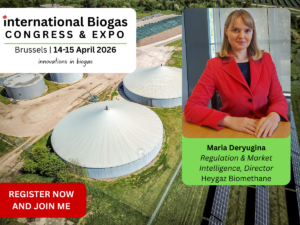






Maria Deryugina, director of regulation and market intelligence at Heygaz Biomethane, will outline the company’s experience of building a multi-country biomethane platform at this year's International Biogas Congress & Expo.
Heygaz is a European biomethane developer, producer, and operator headquartered in Spain, focused on anaerobic digestion and agro-industrial feedstock treatment. The company is present in five European countries – Spain, Portugal, Greece, Ireland, and Norway – and currently operates nine plants with four more under construction. Its goal is to reach 1.5 TWh/a of capacity by 2030, connecting regions with strong biomethane potential to sectors targeting decarbonisation.
Founded at the end of 2023, Heygaz has grown rapidly from two plants in operation to 200 GWh/a of installed capacity today, with a portfolio of more than 20 projects at various stages of development across multiple jurisdictions. Deryugina attributed this growth to careful selection of developers with solid project progress, successful M&A activity in less mature but high-potential markets such as Ireland and Greece, and a team combining more than 25 years of technical experience with strong commercial expertise in the gas and LNG sector.
Deryugina’s presentation will focus on Heygaz’s portfolio approach to European expansion and the learning curve the company has built across its five markets. By systematically transferring best practices in technical, environmental, and commercial operations between countries, Heygaz is able to accelerate project delivery and de-risk investment. “We combine local execution with central knowledge, enabling us to build a scalable and efficient platform,” she explained, adding that the company adapts to local regulations whilst maintaining high industrial and HSE and ESG standards throughout.
On the question of opportunities, Deryugina pointed to the growing pressure on industries to decarbonise and biomethane’s unique position as a drop-in, low-carbon gas that can immediately replace fossil natural gas in heating, power, and heavy transport without major infrastructure changes. She also highlighted the regulatory framework under development, which she expects to enable more efficient allocation of biomethane to demand sources across the continent.
However, challenges remain. Deryugina cited uneven transposition of REDIII across member states, delays in implementing demand incentives, issues with the functioning of the Union Database, and lengthy permitting processes as significant barriers. “All this creates a lot of uncertainty and prevents the market from its own development, relying on subsidy rather than market fundamentals and cross-border EU trade,” she said.
Deryugina said she values the conference as an opportunity for the kind of personal, offline networking that enables meaningful exchange on market developments, emerging positions, and forecasts from a wide variety of players.
Sign up here: https://bioenergy-news.com/conference/
Heygaz Biomethane highlights pan-European portfolio approach to scaling renewable gas