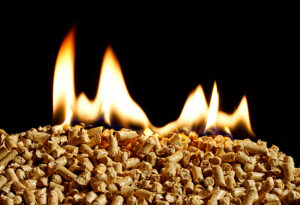






Household wood-burning emissions in Flanders have risen sharply in recent years, even as official figures submitted to European authorities indicate a decline, according to an investigation by Flemish public broadcaster VRT.
Data collected through field measurements by the Flemish Environment Agency (VMM) show that concentrations of benzo(a)pyrene — a carcinogenic compound associated with wood combustion — increased by 44% across monitoring stations in 2022. The agency linked the rise to greater reliance on wood burning during the energy crisis.
However, the emissions data officially reported by the Flemish government to European institutions present a contrasting picture.
Based on modelling rather than direct measurements, the reported figures indicate that benzo(a)pyrene emissions fell by 16% in 2022.
In 2023 — a year that saw record stove sales — the model suggested emissions declined further to their lowest recorded level.
Stove sales surge
Sales of wood and pellet stoves increased markedly over the same period.
More than 19,000 units were sold in 2022, representing an increase of over 40% compared with 2021. In 2023, sales exceeded 20,000, around 240% higher than in 2019.
Questions over modelling approach
According to VRT’s findings, the divergence between measured and reported emissions is rooted in the methodology used to estimate pollution levels.
The Flemish authorities do not maintain comprehensive records of the number of wood-burning stoves in operation, nor do they systematically track their type, age or efficiency. Although improvements to data collection were pledged in 2018, comprehensive sales data are still not routinely gathered.
A refinement study commissioned by the VMM in 2019 was based on a survey of 596 households. Researchers cautioned at the time that the approach carried substantial uncertainties and recommended that authorities obtain more robust sales data — a step that has yet to be implemented.
The current model estimates wood consumption using “degree days”, which are calculated from average daily temperatures.
Colder conditions result in higher assumed fuel use. As 2022 was relatively mild, the model projected lower emissions, despite high stove sales and measured increases in pollution.
The model also does not factor in energy price fluctuations. During the 2022 energy crisis, rising gas and electricity costs prompted many households to switch to wood heating.
Geert Molenberghs, a biostatistician affiliated with KU Leuven and Hasselt University, criticised the methodology, arguing that the emission estimates appear unrealistic and risk understating potential health impacts.
In its most recent Air Policy Plan progress update, the VMM acknowledged significant uncertainties in its estimates, citing limited information on the composition and age of the stove fleet and a lack of comprehensive data on new installations.
Flemish wood-burning policy faces scrutiny as emissions climb