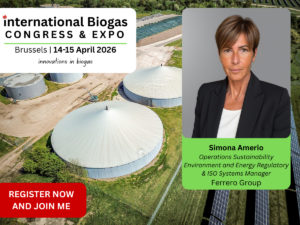






Simona Amerio, operations sustainability environment and energy regulatory & ISO systems manager at Ferrero Group, will share the confectionery giant's experience with bioenergy solutions at the 2026 International Biogas Congress & Expo, emphasising what large industrial end-users need to engage at scale.
Ferrero's sustainability approach is deeply embedded in its long-term business strategy and guided by a science-based, value-chain perspective, Amerio explained. The company's decarbonisation pathway focuses on three main levers: energy efficiency, electrification, and the use of renewable energy, complemented by responsible sourcing and circularity initiatives.
Within this framework, bioenergy and biomethane play a targeted but strategic role, particularly for industrial processes and geographies where full electrification is not yet technically or economically viable. "Rather than viewing bioenergy as a transitional solution, we see it as a complementary decarbonisation lever, especially when it is based on waste or by-products and embedded in circular value chains," Amerio said.
The company's priority is to ensure that any renewable energy solution delivers real, measurable emissions reductions, is scalable, and aligns with its broader environmental and social commitments, she added.
Offtaker requirements
Amerio's presentation will focus on the role of biomethane and bioenergy from an offtaker's perspective, highlighting what large industrial end-users like Ferrero need in order to engage at scale.
"The key message is that demand for biomethane exists, but it must be supported by projects that are robust from a technical, regulatory, and sustainability standpoint," she said. Long-term value is created when bioenergy solutions are reliable, transparent, and integrated into broader decarbonisation strategies, rather than treated as standalone initiatives.
From Ferrero's experience, collaboration across the value chain – from developers to policymakers – is essential to move from pilot projects to scalable solutions, Amerio explained.
Project evaluation
Ferrero applies a structured and multi-disciplinary evaluation framework when assessing bioenergy and biomethane opportunities, she said. This includes environmental integrity, regulatory compliance, operational reliability, and economic viability over the long term.
A key element is sustainability additionality. "We prioritise projects that are based on waste or residual feedstocks, avoid competition with food systems, and demonstrate clear lifecycle emissions benefits," Amerio explained.
Equally important are security of supply, traceability, and contractual robustness, particularly for biomethane projects linked to manufacturing sites or supply chain partners. Ultimately, projects must be aligned with Ferrero's climate targets whilst meeting the operational standards of a global FMCG group, she added.
Opportunities and challenges
From a global FMCG perspective, the main opportunity lies in bioenergy's ability to address hard-to-abate emissions, especially in thermal processes and in regions where renewable electricity penetration remains limited, Amerio said. Biomethane, in particular, offers a pathway to decarbonise existing gas-based infrastructure whilst supporting circular economy models.
However, the challenges are significant, she added. They include regulatory fragmentation across markets, feedstock availability and logistics, scalability constraints, and the need for long-term price and supply stability.
"For global FMCG companies, consistency and reliability are critical – solutions must be replicable across geographies without increasing complexity or risk," Amerio said. Addressing these challenges requires closer alignment between industry, policymakers, and technology providers.
Industry collaboration
Amerio said she sees the conference as a valuable platform for open, pragmatic dialogue between energy producers, technology providers, policymakers, and industrial offtakers. For Ferrero, participation is an opportunity to share expectations, learn from market developments, and contribute to shaping solutions that are both ambitious and realistic.
Collaboration with the bioenergy industry is essential to accelerate progress, she explained. "By working together on standardisation, transparency, and scalable business models, we can help create the conditions needed for wider adoption of biomethane and bioenergy solutions," Amerio said.
She added that partnerships – not isolated actions – will be key to delivering meaningful decarbonisation at the pace required.
Register here: https://bioenergy-news.com/conference/
Ferrero highlights offtaker perspective on biomethane scaling