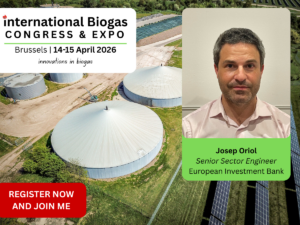






Josep Oriol, sector engineer within the Bioeconomy Division at the European Investment Bank, will outline how the EIB approaches financing for biogas and biomethane projects at the 2026 International Biogas Congress & Expo, emphasising the various channels through which developers can access funding depending on project scale and structure.
Oriol’s background is in industrial engineering specialised in water and economics. Before joining EIB, he worked in designing, building and operating water, wastewater and irrigation systems, with responsibilities in business development, particularly in the Mediterranean area and Latin America. As an operator, he ran several anaerobic digestion plants.
In his current role, he appraises and monitors biogas and biomethane projects, both when EIB is on the lead or as technical support for the other institution of the EIB Group: the EIF, the EU’s specialist vehicle for venture capital, guarantees and microfinance.
Accessing EIB financing
Oriol’s presentation will focus on the different ways of approaching EIB in the bioenergy market, sharing the bank’s experience and views of the challenges encountered whilst explaining its eligibilities and conditions.
“For us it is also important to get the updates from the market needs and the trends on regulation,” he said. “We pay attention to the specificities that each country or segment might present.”
The presentation will include the volumes of financing made available for the sector through different products.
Deployment channels
Project finance is not one of the relevant ways of intervention for EIB in the sector, Oriol explained, exactly because of the lengthy structuring and numerous conditions to be ringfenced before reaching bankability.
“Instead, we are more effective in deploying capital (equity) to fund managers that will, at their turn, invest in a portfolio of greenfield and brownfield projects,” he said.
Alternatively, the SPV structures are below a corporate structure—typically carbon fuel industry that has a decarbonisation path—to which EIB approves a corporate loan. There are no cross-border bioenergy projects; infrastructure, by definition, is very local, he added. Biomethane molecules can be purchased on the basis of biomethane purchase agreements if the countries have a guarantee of origin scheme in place.
Opportunities and challenges
From a global perspective, the main opportunity lies in bioenergy’s ability to address hard-to-abate emissions, especially in thermal processes and in regions where renewable electricity penetration remains limited, Oriol said.
EIB sees large tickets through fund managers that can have a diversified portfolio in terms of country, feedstock and regulatory risk and have a good multiplier in terms of fixed capital formation and capital deployed, he explained.
The market shall evolve, after the 2030 targets set by REPowerEU, into a consolidation of large operators with the capabilities of designing, constructing and operating facilities, similarly to what happened in the 1990s with wastewater treatment deployment in Europe, he added.
Through intermediate finance with commercial banks, EIB can achieve significant volumes by aggregating a large number of individual farmers or SMEs willing to develop local facilities. Current figures (last six years of approvals) show that EIB mainly deploys its loans and equity participation 40 per cent through intermediate operations, and 30 per cent both through equity and through corporate loans.
In these years, EIB has helped mobilise approximately EUR 5 billion in assets, which is a significant share of the ambitious REPowerEU plan (13 per cent as of 2030 estimations).
In terms of challenges, Oriol said EIB expects more homogeneous national and regional legislations in terms of subsidies, feed-in tariffs, permitting, circularity of the digestate, guarantees of origin and proofs of sustainability.
“Currently, some countries authorise practices that others not, making difficult the finance allocation in terms of environmental, social and other risks,” he said.
A great challenge to achieve 2030 targets will be social acceptance, he added. “The projects need to be prepared well upfront and count with the communities, explaining the benefits and mitigating the risks.”
Industry engagement
Oriol said he sees the conference as a valuable platform to make the EIB visible to the community and explain the different channels to reach the bank depending on the ticket size, nature of the promoter, and technological and financial risk.
“We also need to capture the insights from the market in terms of needs and obstacles, as well as the grey areas or ways forward for the legislation, at European and national/regional level,” he said.
EIB has received requests for developing country-focused round tables, since the biogas/biomethane sector has very local concerns, albeit a global role to play in the decarbonisation of industry, the depollution of soil and water bodies, the competitivity of farms, development of rural areas and cohesion regions, and the resilience of European primary energy resources.
Register here: https://bioenergy-news.com/conference/
EIB highlights investment pathways for bioenergy sector