





Cadent has introduced the UK's first cost-sharing model for biomethane network connections, in a move aimed at removing major financial barriers facing renewable gas developers.
The UK's largest gas distribution network has confirmed the new charging approach with regulator Ofgem, which will make reinforcing constrained network capacity more affordable and accessible.
Under the model, where multiple developers are competing for the same capacity, the high costs of reinforcing the gas network can be shared between developers and across the wider customer base through a 'cluster' approach.
Cadent has opened a two-month Entry Reinforcement Assessment Window, running until 6 March, allowing biomethane developers to submit connection projects that could benefit from the new cost-sharing system.
The network operator is targeting a five-fold increase in biomethane entering its pipelines over the next decade, reaching 20TWh by 2035 – equivalent to heating 1.7 million homes.
Currently, biomethane contributes around 7TWh to UK energy supply, with more than half (4TWh) connected into Cadent's four networks.
Major shift from "first connector pays"
Previously, where network capacity was constrained, the first biomethane developer triggering reinforcement was required to fund the full cost, including wider system upgrades – a financial barrier known to have stalled or ended many viable projects.
The new model reduces the burden on individual projects by socialising a large proportion of reinforcement costs across the wider customer base, up to a cost cap. Costs exceeding the cap can be shared across developers where clustering is possible.
The reforms are supported by Ofgem's RIIO 3 Final Determinations, which confirmed an initial £20 million per network "biomethane use it or lose it" allowance for reinforcement, with a £2 million cap per connection project.
Howard Forster, chief operating officer at Cadent, said: "Biomethane is one of the fastest, most cost-effective ways to decarbonise heat today. But the industry has been held back by outdated charging rules that placed the entire reinforcement burden on individual developers.
"This new process – the first of its kind in our industry – moves away from the 'first connector pays' principle. It creates a fairer, more customer-centric path for biomethane projects to connect."
Forster encouraged developers to apply during the assessment window, noting that every application strengthens Cadent's evidence base for future discussions with Ofgem about reinforcement funding and support.
Once the window closes on 6 March, Cadent will assess requirements and cluster applications where possible. Developers will receive reinforcement cost estimates within 15 days and can then decide whether to proceed.
Cadent aims to commence reinforcement works with delivery partners by 29 July, with construction completed in time for new biomethane connections or expansions to connect at agreed dates.
Reinforcement can be delivered through meshing (linking network parts with new pipe), smart network control (installing smart pressure management technology), or reverse compression (moving gas from lower to higher pressure tiers).
Cadent launches UK-first cost-sharing model to boost biomethane connections
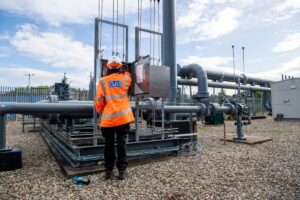
Engineer at AGI
Engineer at AGI