






Clear policy guidance on sustainable biomass sourcing is essential to unlock private investment in bioenergy and support the UK’s transition to net zero, according to Alicia Newton, senior scientific officer at Drax.
Speaking following Drax’s inaugural science summit, Positively Net Zero, held this month, Newton highlighted the UK government’s consultation on a common biomass sustainability framework as a particularly welcome example of policy enabling industrial investment.
“Bioenergy is a key part of the UK’s low-carbon energy mix and will play an increasingly important role in supporting the expansion of intermittent renewables,” she said. “Clear, evidence-based guidance, informed by academic research, on how bioenergy operators should source sustainable biomass gives the industry the certainty they need to secure, grow and innovate their supply chains.”
The summit brought together scientists, academics, government officials and regulators to assess the underpinning science needed to deliver outcomes for climate and nature in Yorkshire, the Humber and beyond.
Newton emphasised that alignment between science, industry and government was critical to meeting climate goals at lowest cost whilst also achieving nature restoration and economic growth. She cited the example of innovative bio-based packaging developed by scientists and corporates to reduce plastic waste, which is ending up in landfill or incinerators because the UK’s waste sector infrastructure is not ready to handle it.
“A huge missed opportunity,” she said.
Newton said decarbonising industrial clusters like the Humber was achievable with existing technology and would make a material difference to UK carbon emissions whilst helping to deliver a just transition for communities. However, achieving decarbonisation required a supportive policy environment to ensure individual companies were not carrying all the risk and that communities could capture economic benefit through localised value chains and secure employment.
The summit also heard that the right policy frameworks were essential to unlock private investment. Newton pointed to UK regulation on biodiversity net gain as creating the investment required to fund land restoration and encouraging developers to make space for nature, enabled by rapid scientific development of sophisticated data packages and models.
“The discussion on nature has rightly shifted from do no harm to actively promoting biodiversity and nature gains,” she said.
Newton said the summit had created a forum for dissemination amongst panellists and participants, leaving attendees with recognition that collaborative work was needed to deliver the promise held by the Humber and surrounding industrial clusters for a just, nature-positive, net-zero future.
Biomass sustainability framework key to unlocking UK investment, says Drax scientist
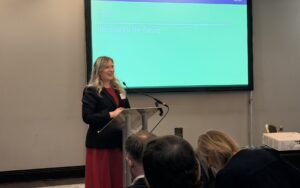
Alicia Newton
Alicia Newton