






A Maryland-based startup says it has developed a biomass processing system capable of almost doubling sustainable aviation fuel (SAF) yields without adding significant processing costs, potentially opening a more economical route to large-scale renewable jet fuel production.
Atlantic Biomass, LLC, working with Ohio State University and Hood College and backed by funding from the US Department of Energy's Small Business Technology Transfer (STTR) programme and the Maryland Energy Innovation Institute, has developed what it calls a Dual Pathway system that can increase biomass-to-SAF conversion rates from approximately 42% to 79%.
The system runs two production routes simultaneously: a conventional biomass-ethanol-SAF pathway and a high-purity syngas feedstock stream, with both sharing the same upstream infrastructure.
The company says the vertical integration of these pathways eliminates intermediate processing costs and enables continuous operational optimisation.
Four key process innovations underpin the system. These include simultaneous ball milling and enzyme hydrolysis — which removes the need for costly thermo-chemical pretreatment — alongside a combined fermentation process that overcomes conversion barriers without increasing costs, and a vessel diameter-to-biomass ratio that converts most input material to a fermentable slurry within a 24-hour cycle.
The intended feedstock is perennial grasses. The DoE's 2023 Billion Ton Report estimates US perennial grass resources could yield 284–535 million tonnes of biofuel biomass annually. Atlantic Biomass says that, by partnering with existing ethanol and syngas-based SAF installations, the system could theoretically produce over one million barrels per day of SAF from domestic grass feedstocks — sufficient to cover all US commercial and freight aviation.
The company is also developing portable versions of the system for deployment in grass-growing regions globally, with the aim of feeding into existing SAF production facilities in Europe and Asia.
Atlantic Biomass claims dual-pathway system could nearly double SAF yields from perennial grasses
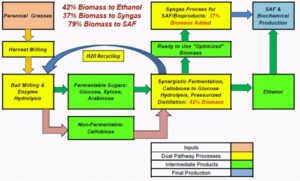
Atlantic Biomass Dual Pathway System
Atlantic Biomass Dual Pathway System