





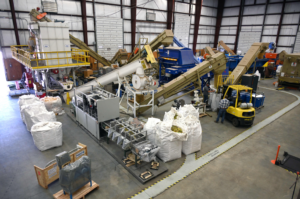
Idaho National Laboratory (INL) is working with Terragia Biofuel Inc. to test new biomass conversion technology aimed at increasing biofuel yields from corn stover.
The collaboration is taking place at INL’s Biomass Feedstock National User Facility (BFNUF), where Terragia is using advanced preprocessing technologies to evaluate its approach to converting plant material into fuels and bioproducts.
The partnership is funded by the US Department of Energy’s Bioenergy Technologies Office and Office of Science.
The BFNUF specialises in preprocessing raw biomass into forms that can be more efficiently converted into synthetic biofuels, which can be used in aviation, rail, shipping and manufacturing.
Terragia is developing technology to convert cellulosic biomass into ethanol, other fuels and co-products at costs intended to be competitive with petroleum-based alternatives.
One of the challenges addressed by the project is the inefficient processing of corn stover — the leaves, stalks and cobs left after harvest. Current methods process the entire plant at once, despite the material being heterogeneous, with some components more difficult to treat than others.
Specialised equipment at the BFNUF allows biomass to be fractionated into individual components, which can then be processed according to their specific chemical and physical properties. This approach reduces waste and improves overall conversion yields.
“Working with INL and its facilities allows us to validate our technology and assess its effectiveness before wider deployment,” said Lee Lynd, co-founder and chief technology officer of Terragia. “Access to state-of-the-art preprocessing equipment enables us to identify the best next steps as we seek to increase bioconversion efficiency.”
The project is expected to increase yields of biomass-derived sugars, which are used across the biomanufacturing and biotechnology sectors. Higher yields could improve supply chain efficiency by increasing the value of processed sugars while reducing production costs.
“The improved yield will ultimately increase the value and reduce the cost of processed sugars used across the biomanufacturing and biotechnology sector,” said John Aston, INL principal investigator for the Terragia project.
The collaboration brings together basic and applied research, combining funding from the Bioenergy Technologies Office, which supports INL’s work, and the Office of Science’s Center for Bioenergy Innovation, which supports Terragia.
Data generated through the project will also allow Terragia to engage with potential commercial partners, while providing INL researchers with opportunities to demonstrate BFNUF’s preprocessing capabilities and validate technologies with potential impact across the US bioeconomy.