







Apr 19, 2024
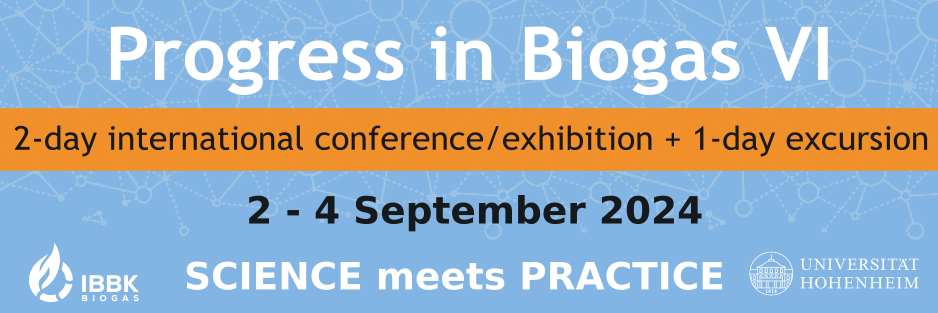
International Biogas Congress and Expo – two months to go!
Biogas News
Apr 19, 2024
After two years of construction, Shell Energy has commissioned its first German bio-LNG plant at the Cologne-Godorf refinery site.
With a capacity of 100,000 tonnes per year, it is the largest of its kind in Germany.
The low-CO2 fuel is sufficient to refuel 4,000 to 5,000 LNG lorries, 15 to 20 vehicles per day.
"We will endeavour to supply the plant with as much biomethane... [Read More]


Other News
Apr 19, 2024
Carbon removals and renewable energy company Drax Group has announced a carbon removals deal with C-Zero Markets (C-Zero), an environmental consultancy.
The agreement is indicative of the maturing carbon market’s growing appetite for high-quality carbon removals and represents another concrete step toward Drax delivering bioenergy with carbon capture and storage (BECCS)... [Read More]
Biogas News
Apr 19, 2024
Vitol has acquired renewable energy company, BioMethane Partners, to form Vitol BioMethane (VBM).
VBM's leadership has more than 100 years of combined experience in designing, building and operating gas collection systems, natural gas treatment plants and pipeline interconnects and injection across the landfill gas (LFG) and traditional natural gas businesses.
VBM has... [Read More]
Other News
Apr 18, 2024
Spanish energy company Cepsa has signed an agreement with Evos, a leading liquid energy and chemical storage company with hubs in strategic locations across Europe, to enable the storage of green methanol to be produced by Cepsa at Evos’ storage facilities in Algeciras and Rotterdam.
The partnership, which also provides for the storage of green ammonia at Evos’ facilities... [Read More]
Biomass News
Apr 18, 2024
The County of Renfrew and Ecostrat have announced the issue of an investment grade BDO Zone Rating for Woody Biomass.
The Zone is centred in Pembroke, Ontario in the US, and is the province’s first ‘AA’ rating for Pulpwood.
Renfrew County’s BDO Zone ‘AA’ rating denotes very high prospective viability of feedstock supply chain and infrastructure, and very... [Read More]
Biogas News
Apr 16, 2024
A new report by Guidehouse has revealed that Europe (EU-27 + UK, Norway and Switzerland) could produce 111 bcm of biomethane by 2040. This amount represents over 30% of the EU gas consumption in 2022.
The European Biogas Assocation (EBA) said that biogases will play an important role in the European Union’s (EU) ambition to achieve a net-zero future by 2050.
Via the... [Read More]
Biogas News
Apr 16, 2024
Air Liquide continues to expand its capacities in biomethane in the US with the construction of two new production units.
These units, located in Center Township, Pennsylvania, and Holland Township, Michigan, will treat waste sourced from dairy farms.
The facilities will produce biogas from manure feedstock in an anaerobic digester for a total production capacity of... [Read More]
Biogas News
Apr 16, 2024
ENGIE has acquired two new units in the Netherlands, which represent the Group's first biomethane production facilities in the country.
Located in Hardenberg (province of Overijssel) and Alkmaar (province of North Holland), these two new plants have an annual biomethane production capacity of 90 GWh and 47 GWh respectively.
Both units can be extended to reach an annual... [Read More]
Features
Apr 15, 2024
Hitachi Zosen Inova updates Bioenergy Insight on its US activity
Volatile energy supplies, rising commodity prices and end consumers who are increasingly concerned that their consumer goods are produced in a CO2-neutral and sustainable manner, to name just three aspects that are becoming more and more important for a wide range of industries. US wine producers and distilleries... [Read More]
Other News
Apr 15, 2024
MOL Group has developed a 10 megawatt capacity green hydrogen plant in Százhalombatta, Hungary, which it said is the largest in Central and Eastern Europe.
The €22 million investment makes fuel production more sustainable: the plant will reduce the Danube Refinery's carbon dioxide emissions by 25,000 tonnes per year, according to the company.
MOL added it will be... [Read More]
Biogas News
Apr 15, 2024
VORN Bioenergy, a leading project developer and biomethane producer, has announced the launch of VORN Bioenergy Italia srl (VORN Bioenergy Italia).
This follows VORN’s acquisition and full integration of Alvus srl (Alvus), a Bolzano-based project developer in the biomethane and biogas sector last October.
As Italy transitions towards greener energy production, biomethane... [Read More]
Policy News
Apr 12, 2024
The chances of Germany switching from fossil methane to renewable methane are not being practically considered, according to the German Biogas Association.
The comment period for the consultation of the Green Paper on the transformation of the German gas distribution grid ends today (12 April).
The strategy paper of the Federal Ministry for Economic Affairs and Climate... [Read More]
Biomass News
Apr 12, 2024
Iran inaugurated the country's largest concentrated biomass power plant that runs on biogas, according to IRNA's report from the Ministry of Energy.
A ceremony was held yesterday (11 April), and was attended by president Ebrahim Raisi and energy minister Ali Akbar Mehrabian, via video call.
Alongside the power plant, water and wastewater projects totaling US$283.33 million... [Read More]
Biogas News
Apr 12, 2024
The further expansion of biogas production in Europe will see the generation of increasing amounts of digestate, according to the European Biogas Association (EBA), as leveraging its significant advantages will yield benefits for farmers, local communities, and producers alike.
The EBA is launching a comprehensive white paper exploring the potential of digestate in fostering... [Read More]
Biomass News
Apr 11, 2024
The U.S. Department of Energy’s Bioenergy Technologies Office (BETO) and Office of Fossil Energy and Carbon Management (FECM) have released the MACRO: Mixed Algae Conversion Research Opportunity funding opportunity announcement (FOA).
The FOA will award up to $18.8 million (€17.5 million) to address research and development (R&D) challenges in converting algae,... [Read More]
Policy News
Apr 11, 2024
The European Biogas Association (EBA) has welcomed yesterday’s (10 April) adoption of the European Parliament Report on the CountEmissions EU proposal, which is based on a well-to-wheel approach, but regrets the decision not to include a mechanism to account for renewable fuels in the scope of the CO2 Emission Performance Standards for Heavy-Duty Vehicles (HDVs) Regulation.
The... [Read More]
Other News
Apr 11, 2024
enfinium, a leading UK energy from waste operator, is progressing plans to invest around £200 million (€233.8 million) in carbon capture and storage (CCS) technology at the Parc Adfer energy from waste facility in Deeside, North Wales, providing carbon removals and boosting the green economy.
The project could capture up to 235,000 tonnes of carbon dioxide (CO2) every... [Read More]
CONNECT WITH US





After two years of construction, Shell Energy has commissioned its first German bio-LNG plant at the Cologne-Godorf refinery site
C-Zero will purchase carbon dioxide removals (CDR) credits from Drax representing 2,000 metric tons of permanently stored carbon under the terms of the agreement
Texas-based landfill gas-to-energy company @vitolnews has acquired renewable energy company, BioMethane Partners LLC, to form Vitol BioMethane (VBM)